At last year’s Oscars, the Nyad biopic was up for two awards, and Diana got to sit in Jennifer Aniston’s lap. “She was crying,” Diana said in a recent interview, “and telling me I was a hero and that the movie meant so much to her.”
It also meant a lot to UraFibber, a Wikipedia editor with one goal: Sabotage the Nyad biopic’s entry.
Detail from “Nyad (film)” revision history. It shows some of the edits UraFibber made on March 9 and 10, 2024.
On Friday, January 19, 2024, Los Angeles Times movie and TV columnist Glenn Whipp wrote, “Oscar nominations arrive bright and early Tuesday morning.” At 1:15 a.m. the next day, a Wikipedia user created a sockpuppet account called “UraFibber.”
According to Wikipedia, a sockpuppet is “a false online identity used for deceptive purposes.” The account holder made 40 total edits, all to “Nyad (film)” and all focused on the 2024 Academy Awards. He made six on January 20, then five on the 24th, the day after the Academy announced the nominations. He made the remaining 29 on March 9 and 10, the day before and the day of the Oscars.
“As a child growing up in Fort Lauderdale, Diana Nyad was a champion pool swimmer.”
Nyad won the Florida High School Class A title in the 100-yard backstroke in 1964 and 1967. That was the extent of her championship pool swimming. In neither year was she the fastest high-schooler in Florida, and many young women nationwide were far faster.
The Facts
1964 Nyad swam 1:10.4 to win the Florida High School Class A title in the 100-yard backstroke. Pat Fleming of Pompano Beach High School took the 2A division in 1:07.3. Cathy Ferguson of Los Angeles won the U.S. Nationals in 1:01.4.
1967 Nyad swam 1:06.7 to win her second Class A 100-yard backstroke title. In other races that year, at least two other Floridians went faster: Nyad’s teammate Nancy Fisher went 1:06.0, and 12-year-old Libby Tullis swam 1:05.1. Kaye Hall of Tacoma, Washington, won the U.S. Nationals in 1:01.6.
Nyad didn’t swim fast enough to qualify for the Nationals in either of those years. In 1964, 38 swimmers qualified in the 100 back and 37 in the 200. In 1967, 46 qualified in the 100 and 39 in the 200. All of them swam faster than Nyad.
She qualified for the Nationals twice in other years:
1966 Short Course Nationals in Bartlesville, Oklahoma
Nyad swam 1:05.2 to place 19th in the 100-yard back. Fifteen-year-old Canadian Elaine Tanner, a.k.a. “Mighty Mouse,” won the event in 1:00.7.
Nyad swam 2:35.5 to place 16th in the 200 back. Fifteen-year-old Judy Humbarger of Miami Shores won in 2:11.8.
1968 short course nationals at the University of Pittsburgh
Nyad finished 36th in the 200-yard back in 2:22.7. Kaye Hall of Tacoma, Washington, finished first in 2:10.8. Hall went on to win a bronze medal in the 200 at the Mexico City Olympics and take gold while setting a world record in the 100.
Nyad knows her resume doesn’t support labeling herself “a champion pool swimmer,” so she often lies about her record. A few examples:
Sports Illustrated, 1971:
In the next three years she won the 100-yard backstroke at six state meets, but she never surpassed her 12th-place finish in the nationals.
Other Shores, 1978:
[Coach Jack Nelson] helped me improve enough within that first year to become the best in the state of Florida at both the 100-meter and 200-meter backstroke. (p. 17)
Philadelphia GeoFest, 2011: And by the age of 14, I was the best in the state of Florida. This is elite swimming. There wasn’t a backstroker faster than me at 100, 200 meters. (5:52)
Find a Way, 2015:
It wasn’t long before I was the best back-stroker in the state of Florida. (p. 44)
“The Courage To Succeed,” 1997:
It came to be that when I was 16 years old I won the United States Nationals. I was the best in the United States. Later that summer, I broke the world record for the 100-meter back stroke. I was the best in the world!
(presentation to the American Railway Bridge & Building Association)
See this spreadsheet for all of Nyad’s available meet results from 1962 through 1968.
“[She] became one of the most renowned ocean swimmers in the world.”
Nyad’s renown comes not from her accomplishments but from her gift for PR.
The International Marathon Swimming Hall of Fame maintains a list of swimming accomplishments they call “The Majors.” Diana Nyad has completed four of them and won two. Only one of them, a race from Capri to Naples, took place in the ocean.
Nyad never finished a single major solo ocean swim. She once claimed that she completed and broke records in them all:
I became, in the 1970s, the best ocean swimmer in the world. I held all the major records on planet Earth, out in the open sea. (Wilshire Ebell—audio clip)
World-record setter Katherine Rawls is a Fort Lauderdale swimmer worthy of a Florida State Historical Marker. No one needs to exaggerate Rawls’ accomplishments:
She was an inaugural inductee into the International Swimming Hall of Fame (ISHOF).
She won U.S. National championships in both swimming and diving. She also won Olympic medals in both sports.
She lived in Fort Lauderdale and trained in the ISHOF’s Casino Pool in the 1930s. She officially opened the Hall’s new pool in 1965.
Nyad says she has five stepchildren, lies about a Nobel Prize winner, and insults every French-speaking person in Québec. Just another day in the Dianasphere.
In August, Diana spoke with Dr. Merav Opher, professor of Astronomy at Boston University and director of the SHIELD NASA DRIVE Center.
Above: A screenshot from SHIELD’s home page. “SHIELD” is an acronym for “Solar wind with Hydrogen Ion charge Exchange and Large-Scale Dynamics.”
The SHIELD Center is an international collaboration of researchers studying the heliosphere, a solar-wind-generated bubble surrounding the solar system. Nyad appeared as part of the SHIELD Center’s webinar series. They called her presentation:
Though Diana Nyad didn’t follow traditional marathon swimming rules on her Cuba-to-Florida attempts, she has always insisted that she never touched the boat, pushed off the boat, or received help moving forward or staying afloat.
Recently unearthed footage from 2011 shows her going three for four.
Three days after Diana Nyad’s “successful” 2013 Cuba-to-Florida attempt, lead kayaker Don McCumber (as @Woodkayaker) wrote on the Marathon Swimmers Forum that he had video of “water breaks, feeding breaks, medical breaks, the application of anti-jellyfish creams, and the donning of the ZERO FLOTATION suit and mask” (archived).
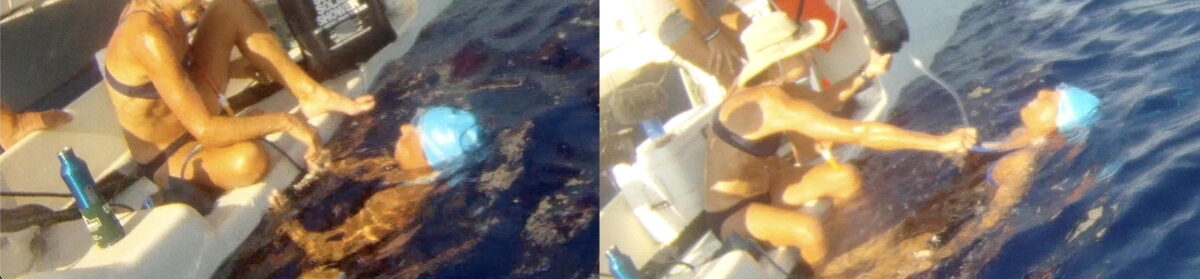
Little of that footage materialized. These creenshots from McCumber’s 2011 video suggest why he might have withheld it:
Screenshots of footage from Diana Nyad’s September 2011 Cuba-Florida attempt. The images show Nyad touching her guide boat and being held up by a crew member, an episode that lasts at least 60 seconds. (Clips here [184MB]. The first clip shows Nyad possibly kicking off the boat.)Continue reading →
“Never Ever Give Up: How Diana Nyad Swam from Cuba to Florida,” from the BBC World Service podcast Lives Less Ordinary, may have contained more misinformation and lies than any other Nyad-related podcast episode.
The sun rises and sets, the tides ebb and flow, Diana Nyad lies and lies. Nothing surprising about any of those things. But when a BBC producer lied to me about fact-checking Diana Nyad:
All records and data cited within the Diana Nyad edition have been independently verified by the appropriate sporting bodies.
No sporting body would have verified
In a follow-up message, she said
We’ve looked into your other comments and can find no evidence to warrant further changes to the programme other than the factual errors as detailed above.
They either didn’t look very hard, or they didn’t look at all.
Below, I’ve listed some of the original episode’s misinformation and lies. They have since made three corrections, and the episode’s web page state that “This programme has been re-edited and corrected since first published.”
I’m grateful they did this. However, “corrected” suggests that
They changed the following
[She swam] across Lake Michigan.
Ms. Nyad was the Women’s World Marathon swimming champion from 1970 to 1975.
[She] set a world record for distance swimming for both men and women, when she completed 102 miles, or 164 kilometers, from the Bahamas to Florida.
Like many of her “records,” this one is entirely self-declared and imaginary. Her Bahamas-to-Florida swim was a 60-mile endeavor. For details, see the “Swimming to Jupiter” section of “Diana Nyad’s Magic Marker.”
Internal clock
Nyad says that she can “count time out there like an atomic clock.” If so, it’s an atomic clock that’s about to explode. She gives no examples here for good reason. Whenever she does, she proves she’s lying. For instance, she said in a speech that singing “Me and Bobby McGee” 1000 times takes her “to the second, 9 hours and 45 minutes.” However if she sang it the way she says she did, it would take her 75 hours. She said in another speech that 2000 times through the same song takes her 8 hours and 45 minutes.
Diana only happened to discover [marathon swimming] while at University. A fellow student saw her doing laps in the pool and said, “Do you know there’s a sport called marathon swimming.”
Buck Dawson, founding director of Fort Lauderdale’s International Swimming Hall of Fame, introduced Nyad to marathon swimming in 1970. or ’71. A fellow student had nothing to do with it. See her first memoir, Other Shores:
Buck Dawson, an old friend, called with a tempting prospect of trying the marathon swimming circuit. . . . He and his wife run a competitive swimming camp for girls in the north woods of Ontario, about four
hours up from Toronto. (p. 20)
“Many people to this day come up to me and say, ‘I was there that day.'”
She’s confusing that with her Cuba-Florida crossing. Beginning of swim (according to NYT): “Little knot of bystanders.” “100 newsmen and well-wishers” at end.
The Mount Everest of swims
For me and for lots of other people, Cuba was the one. Cuba was considered the Mount Everest of all the swims on Earth.
Few people have wanted to swim from Cuba to Florida. However, Nyad often says otherwise: “All the great swimmers of the ocean have tried it,” she told an interviewer in 2017, “male, female, young, strong, fast” (Brink of Midnight podcast). Five people have attempted the crossing; three have succeeded. For details, see my post, “Everybody’s Doin’ It.”
No one besides Nyad considers the Florida Straits the Mount Everest of marathon swimming. Again, she wants us to think otherwise:
Now another elite Australian swimmer named Chloë McCardel has her sights on being the first to cross without aid. . . . She is issuing statements about the Cuba Swim being the Mount Everest of ultradistance swimming. (Find a Way, p. 244)
I started that little tickle in the back of the imagination that my mom had planted about “Cuba’s right over there. As a matter of fact, it’s so close you, you little champion swimmer there, you could actually swim there.”
She began workshopping that myth around 2014. It contradicts all the versions she told earlier, when she was more honest about her motivation: “If I make it,” she told a New Jersey newspaper, “I’ll be rich and famous — mostly rich.” See the “Discovering Cuba” summary for more versions of her story.
Bragging rites
“I was in the best physical shape of anybody on the face of the earth for that day, the best prepared for my task.”
[1978 — who else was swimming? But Nyad wasn’t paying any attention to them. To Nyad, there’s only one person marathon swimmer worth talking about.
there’s no way to tell. You can’t compare marathon swims. but let’s look at what some others did in 1978.
John York completed a double-crossing of the Catalina Channel in. He described his training regimen in a 1979 article…
Penny Dean (July 29) — first EC under 8:00. A week (?) later, she placed second at the World Championships.
Cindy Nicholas — single EC, had done a double in 1977, would double again in 1979.
Des Renford — swam the English Channel twice (at age 50). He’d swim it three times in 1979 and three more in 1980.
Cindy Cleveland — Anacapa two-way (first single & first double). In 1979, she would become the first person to swim around Catalina.
Loreen Passfield swaswam the English Channel in 9:02 on August 28, won the world championship crown in 1978 and
“I do believe I have spent more training hours than any other swimmer in history.”
She can’t know that, particularly because she’s never had much interest in other swimmers beyond convincing the press and public that she’s better than they are.
Superhuman resilience
That superhuman resilience, that obstinate refusal to give up. She’s cultivated and nurtured that quality over a lifetime.
“It’s almost like I took a steel helmet of conviction, and I put it on, and I said, ‘There is nothing that would be a surprise to me that will keep me from taking the next stroke and the next stroke.'”
“It doesn’t matter how bad it gets once I put on that imaginary steel helmet; there’s nothing that’s going to keep me from going except Mother Nature.”
No — sometimes she just quits. She makes excuses for her failures on the spot or later.
‘She has a tremendous reputation for not finishing races,’ complains Tom Hetzel, seven-time conqueror of the English Channel. ‘She has gotten more publicity for doing less than anyone I know.’ (People Magazine, 1976)
From Doc Counsilman:
By taking on the Channel, Counsilman also hoped to help plot a truer course for a sport that he feels is being exploited by “phony-baloney promoters.” He cites the example of Diana Nyad, “a very mediocre swimmer with a very good publicist. Most of her swims have been failures. (Sports Illustrated, 24 Sep 1979)
John Kinsella, Olympic medalist, world record holder, and 5-time World Professional Marathon Swimming champion:
Diana is such a joke to anybody who knows anything about marathons. (Chicago Tribune, 27 Aug 1978)
Nyad’s greatest strength isn’t resilience but PR, getting the public and the media to believe her and even lie for her.
Broadcasting career
“Over the following three decades, Diana forged a successful broadcasting career.”
She started with ABC in 1980. By 1987 — after she had “worked out a free-lance arrangement with ABC,” presumably Nyad-speak for “they let me go” or “my assignments dried up to almost nothing” — she’d begun plying her trade elsewhere. Some examples:
Nyad was mostly doing radio by the 2000s. In her 2015 memoir, Find a Way, she says that The Score, her sports commentary spot that debuted on NPR affiliate KCRW in 2004, was her most fulfilling broadcast job.
She also says it lasted 22 years (Find A Way, p. 100).
You’re in this state of extreme sensory deprivation.
Nyad confuses sensory deprivation with boredom. She told the New York Times that marathon swimming “is the most boring sport in the world.” However, she needs to portray her endeavors as one torment after another, and boredom doesn’t sound as agonizing as sensory deprivation.
Swimming is closer to sensory overload than sensory deprivation. From the moment an athlete enters the water, swimming engages all five senses. Here’s Nyad talking about her 2013 crossing:
“The waves are slapping all night long.” (Find a Way, p. 258)
“The sun is hot and life-affirming.” (259)
“Salt water washing over those cuts now causes a constant, throbbing torment.” (259)
“And I see Bartlett’s head peering out his window, right above the handler’s station. He gives me a big thumbs-up, that grin still beaming ear to ear. (261)
“You’re turning your head. For me, it’s 53 times a minute, like clockwork.”
Jack Nelson sexually abused her from the age of 14.
Box jellyfish
“The doctors on board will tell you that they think I lived on will. I should not have survived those things. Many people who were touched by the box die instantaneously. Within a minute or two.”
“If you’re not going north, you’re going to be dragging east and off course by the Gulf Stream.”
Diana had done it. Thirty-five years after her first attempt, over 50 years since she first saw that mysterious island in the distance, she’d swum from Cuba to Florida.
Diana’s ability to deceive the public and the media, including the BBC, demonstrates how well she absorbed her step-father’s lessons.
On January 12, 1943, Beverly Hills police took Aristotle Nyad into custody at the Beverly House Hotel while he posed as a Greek military hero. He told his marks that he needed funds to help him return to Greece to fight the Nazis, something he had no intention of doing.
Eleven years ago today, Diana Nyad walked ashore in Key West to complete the farce that launched a thousand speaking engagements, not to mention a memoir, a biopic, and boundless adulation for marathon swimming’s most successful liar.
Diana Nyad celebrating the day after her 2013 crossing. Image by J. Pat Carter, Associated Press, via Miami Herald.
Not only is today the eleventh anniversary of Diana Nyad’s Cuba-Florida crossing, it’s also the first anniversary (plus two days) of Evan Morrison’s announcement that he had changed his mind about Nyad’s “swim,” and it was “time to move on.” Continue reading →
In a lawsuit filed on Friday, Quinn Fitzgerald, director of the World Open Water Swimming Association (WOWSA), alleges that Steven Munatones breached the WOWSA Dissolution Agreement that he and Antonio Arguelles signed last May.
The complaint, which also names Arguelles and Gerry Rodrigues as defendants, alleges that Munatones never intended to follow the terms of the agreement. It further asserts that Munatones only signed so Fitzgerald would consent to the agreement’s stipulations, including a date-specific non-disclosure section that could be the entire reason Munatones wanted Fitzgerald’s signature.
(The complaint is publicly available for free on the San Francisco County Superior Court’s website., but I posted it here for easier access. The document includes The Dissolution Agreement as Exhibit A.)
In particular, the complaint alleges that, once the Dissolution Agreement took effect, Munatones and Rodrigues “orchestrated a scheme” to remove Fitzgerald as the Open Water Swimming Facebook group’s administrator — despite the agreement making Fitzgerald the group’s sole owner.
Munatones and Rodrigues succeeded in removing Fitzgerald and now administer the group.
Twenty years after journalist Rebecca Morris met Diana Nyad in Gertrude Ederle’s den, an anthology of writing about swimming put Morris and Nyad together once more, giving us a chance to celebrate Morris and expose more of Nyad’s lies.
Author/speechwriter/swimmer Rebecca G. Morris — not to be confused with journalist/editor/true crime writer Rebecca T. Morris or artist Rebecca no-middle-initial Morris — wrote a series of quirky features for the New York Sunday News in the 1970s.
For example, she surprised foodie friends with a meal of camping cuisine in “I freeze-dried my dinner party.” In “The Scuba Cops,” she documented a day she spent with the NYPD’s Underwater Recovery Team as they searched for cars, guns, and bodies. And in “The Challengers of the Channel,” Morris chronicled a meeting between Diana Nyad and Gertrude Ederle. (I’ve written previously about Nyad lying to Ederle during that meeting.) The Sunday News published “Challengers” on August 1, 1976, five days before the 50th anniversary of Ederle becoming the first woman to swim the English Channel.
When “Young Woman And The Sea” opened in theatres in May, reviewers and headline writers suggested that Nyad and Ederle share more than a gender, a sport, and a recent biopic. They were wrong.
“Young Woman and the Sea” begins streaming today, so it’s a good time to look at why Gertrude Ederle is one of the greatest swimmers of all time, and Diana Nyad is one of sports’ all-time greatest liars.
Next month, Diana Nyad will bring her memoir to East Hampton, New York, just up the road from where her mother spent much of her toddlerhood. In an interview with a Hamptons-based magazine, Nyad tells her usual tales. More tantalizing, though, are the tales she doesn’t tell.
Above: The biographies of Robert Caro (top left) of New York urban planner/public official Robert Moses and U.S. President Lyndon Johnson have earned him two Pulitzers, two National Book Awards, and too many other honors to list here. On the top right is MSNBC’s Joy-Ann Reid, whose book “Medgar & Myrlie” the New York Times calls “a 352-page love letter” to civil rights leaders Medgar and Myrlie Evers. Neil deGrasse Tyson and Nelson DeMille will have to fend for themselves biographically because this caption’s already too long. The fifth author doesn’t belong with the other four.
On August 5, 1922, about 300 guests arrived at the Southampton summer home of George Warrington Curtis — an heir to the Mrs. Winslow’s Soothing Syrup patent medicine fortune — for what The New York Herald called a “fete Champetre,” a “party in the fields.”
Curtis had asked guests to arrive at his 100-acre Captains Neck Lane estate before ten p.m. Driving onto the grounds after that would be too dangerous; all lights would be on the night’s entertainment: The Marion Morgan Dancers.