

At the end of May, two expert illusionists — David Blaine and Diana Nyad — met onstage at the Outside Festival in Denver, Colorado. During the festival, Nyad also sat for an interview with off-road cycling champion and founding director of the “Be Good Foundation,” Rebecca Rusch. Nyad proved that, after half a century of lies, she can still come up with breathtaking new ones.
The Manhattan Swim: What About Chuck?
Nyad’s most brazen new lie involves the motivation for all her endeavors.
I started to research [the Manhattan swim] and wound up, you know, breaking the record for men and women there, and that sort of put me on a map. I didn’t even intend it. I didn’t have a publicist. I didn’t let anybody know except our official team. (1:04:47)
Nyad swam around Manhattan for one reason: Publicity.
She began competing in pro marathon races in 1970. For the first few years, she attracted some public attention. But faster swimmers began joining the tour in 1973, and Nyad couldn’t keep up. All U.S. publicity began spotlighting the tour’s new stars, Ohioans John Kinsella and Sandra Bucha. So Nyad quit racing, hired publicist Chuck Jones, and started focusing on solo swims. Jones told me in an email that he suggested the Manhattan swim “to raise [Nyad’s] profile.” Newspaper accounts refer to Jones variously as Nyad’s agent, manager, coach, and “public relations man.”

In her first memoir, Other Shores (1978), Nyad wrote that Jones “sent word out to all the press” about her Manhattan swim (52). Reporters and photographers even covered Nyad’s training swims. She was finally getting the attention she felt she deserved:

Every square inch of the sea wall was crowded: newspaper reporters scurried around with their spiral notebooks flapping, pens behind their ears; radio interviewers shoved their mikes in my face; the television crews tried to set up amidst the chaos. I spoke with them all. (Other Shores, 54)

A month after Nyad swam around Manhattan, she told a reporter that “The day to day motivations are fame and fortune . . . I want very much to be recognized.” Sometime later, though, she started lying about her motives. She wrote in her 2015 memoir, Find a Way, that “My motivations in doing the Manhattan swim were high-minded” (66).


Garnishing An Aoki Whopper
Nyad tells Rusch that adventurer and Benihana restaurant founder Rocky Aoki handed her a big check for her first Cuba-to-Florida attempt:
I was in his office for 10 minutes, and he wrote me a check for $300,000, which, in today’s world, maybe not much, but in 1978 that would be like millions. (12:55)
Fifty years of deceit worked wonders for Nyad’s fund-raising acumen. According to a 1978 article in the Miami News, Aoki gave Nyad the only sum that is worth today exactly what it was worth then: Nothing.
Nyad included the 300,000-dollar lie in Find a Way:
I will say that fund-raising for the event came through in a ten-minute meeting. [Mr. Aoki] asked how much it was going to cost. I told him $300,000. . . . I left Mr. Aoki’s office with a check for the full amount. (83)

But with Rusch, Nyad wasn’t content reprising the fake payday, so she ad-libbed some details about Aoki: He “Loved the ocean . . . He loved surfing, he loved bodysurfing, he loved boating, he loved yachting, he loved all that” (12:00). No sources, including two biographies, offer corroboration. Truth may be stranger and more fascinating than fiction, but Nyad chooses fiction every time.
More truth about Aoki: He was a national-calibre wrestler, winning titles in Japan and the U.S. He was part of a four-person crew that completed the first balloon crossing of the Pacific. And he especially loved powerboat racing. Nyad could have talked about the 1979 Aoki-sponsored Benihana Grand Prix of Oakland. During test runs for the race, Aoki’s boat slammed into a wave and came apart near the Golden Gate Bridge. He suffered liver damage, a broken leg, a torn aorta, and likely would have died if a crew member hadn’t resuscitated him in the water.

Nyad also could have mentioned Betty Cook, the era’s only woman powerboat racer. An MIT grad who didn’t start racing until her fifties, she designed her own boats and built her own engines. She clinched her second straight U.S. National Offshore Powerboat Racing Championship in the same race that almost killed Aoki. Cook is such a legend in powerboat racing that her boat, KAAMA, has its own Facebook page.
But facts limit Diana, and she hates limits. So she adds surfing, bodysurfing, and yachting — three pointless fictions that serve no purpose beyond proving that she won’t be bound by anything as mundane as the truth.

Below: Cook in her Newport Beach, California, engineering shop in 1980. After winning the 1977 world offshore powerboat championship, she told the New York Times that “I had a point to prove. You don’t have to be a gorilla to drive a boat. There are other talents you can bring to bear and still be successful.” Image via Sports Illustrated.


Diana’s DIY Olympics
In 1971, Diana, then 22 years old, told Sports Illustrated: “I haven’t come close to my potential in marathon swimming yet, but I’d trade all of what I’m going to be for an Olympic gold medal.” But Nyad was never fast enough to qualify for the Olympic Trials, let alone win Olympic gold. She never came to terms with that failure. So she built herself an imaginary awards podium and has spent her life kicking everyone else off.
Within the Rusch interview’s first minute, Nyad boots all pool swimmers. She focuses on Katy Ledecky, winner of nine Olympic gold medals and 21 World Championship titles. “I do bow down as she walks by,” Nyad tells Rusch. “But when you add endurance in it, now you’re talking about things that people in life around the world have to face. . . . battling cancer or . . . a 60-hour childbirth [or] raising a disabled child” (00:48).
Someone needs to tell Diana that it’s absurd to compare something as unmeasurable and subjective as suffering. While they’re at it, they could remind her that swimming is voluntary.Not so with cancer, raising a disabled child, becoming quadriplegic, being imprisoned in a concentration camp, or any of the other traumas Nyad mentions in the interview.
“What does the mind go through?” she asks herself about long swims. “And this is where I think that, you know, we can jump from us as athletes to people who need to survive” (2:58). No, we can’t — unless we’re Diana Nyad, who parasitizes the involuntary suffering of others to generate sympathy for herself.
Once Nyad dismisses Ledecky and pool swimming, she goes after all other endurance sports. “Never to compare by any sort of, you know, superiority level,” she says before comparing superiority levels. Nyad judges participants in all other endurance sports — including off-road cyclists like Rusch — inferior to marathon swimmers.
Finally, Nyad must reckon with the greats of her own sport. As she does with pool swimmers, she zeroes in on one athlete:
But one thing that we, the few of us — Sarah Thomas is one, four times consecutive English channel in 54 hours blows your mind — she and I are probably the only two, really, you know, who know what it’s like long, long hours.*
*At least six other swimmers have completed unassisted swims of 50 hours or more. An “unassisted” swim follows traditional marathon swimming rules, a.k.a. English Channel (EC) rules. For a summary of EC rules, see “What exactly are English Channel rules?” under “Frequently Asked Questions” at the Channel Swimming & Piloting Federation website. If Nyad had completed her Cuba–Florida crossing under her own power — she didn’t — it would have been an assisted swim.
But two is one too many for Diana. Thomas is one of the greatest marathon swimmers of all time. She holds the record for the longest continuous, unassisted, current neutral swim: 104.6 miles in 67 hours, 16 minutes (Lake Champlain, September 2017). Her English Channel 4-way took two hours longer than Nyad’s alleged Cuba-Florida crossing. The London Times likened Thomas’s feat to Edmund Hillary’s Everest ascent and Roger Bannister’s sub-four-minute mile. Nyad again feigned respect — “I bow down to her unwavering spirit” — before shoving her off the podium: The Cuba–Florida crossing, Nyad tells Rusch, “is for a whole host of reasons, the most difficult swim in the world.”

More difficult, presumably, than completing the actual Mt. Everest of marathon swimming four times back-to-back in water more than 20 degrees colder than the Florida Straits, all while following traditional marathon swimming rules. Nyad doesn’t tell Rusch that she attempted the English Channel three times, couldn’t get across once, and never tried again.
“This is my Olympics,” she says matter-of-factly. . . . “The Cuban swim is the greatest endurance feat in human history. But if anyone can do it, I can.” (Philadelphia Inquirer, 10 Aug 1978)

Coming In November, A Monument To A Monumental Liar
The rhetorical tactic of calling attention to something by saying you won’t call attention to it is called “paralipsis.” Nyad uses paralipsis to boast and belittle while feigning kindness and humility. As in saying, “Never to compare superiority levels,” then comparing superiority levels. (Or saying, like she did in 2017, “Never to denigrate any of the great swimmers,” then denigrating two athletes far superior to her, Australian marathoners Penny Palfrey and Chloë McCardel. Nyad “bow[s] down in front of them,” too.)
Nyad tells Rusch,
I don’t want to, you know, bring up awards and stuff like that. But because we’re talking about that beach, on that very beach, which is the most prominent beach in Fort Lauderdale, this November, they’re going to put a state historic marker up to my swim. (34:14)
“That very beach” is Las Olas Beach in Fort Lauderdale, Florida, where Nyad grew up. In 2014, she began claiming that her mother planted the idea for the Cuba swim while they were at Las Olas. Nyad plans to tell her mom-at-the-beach story during the marker’s unveiling. Here’s the version she tells Rusch:
I was a little swimmer at age nine, yeah, little champion swimmer, nine-year-old. And I was standing with my French mother on the shore at age nine, and I said, “Mom, I know Cuba is out there, but it’s supposed to be very close. Where is it? I can’t see it.”
She said, “Well, it’s just this way. No, it’s this way already. As a matter of fact, it’s so close, you little champion swimmer, you could actually swim there.” (33:36)
Nyad also says she started at 11, 10, 8, and “just 7.”
But she didn’t begin swimming competitively until she was 12. As for the idea to swim from Cuba to Florida, Nyad wrote in Other Shores that it came to her while she was in her New York apartment looking at nautical charts.

The chart story may not be true either. Nyad could have gotten the idea from Ohio baker Walter Poenisch. He began planning a Cuba-to-Florida swim by 1967 and completed his crossing in July 1978. Before, during, and after Poenisch’s swim, Nyad slandered him in the press, costing him all his sponsors. He sued Nyad and won an out-of-court settlement. Also, Nyad’s mother was American.


We may never know the exact source of Diana’s Cuba–Florida inspiration. But we do know it wasn’t Lucy Nyad. We also know Diana’s motivation. It was the same hunger that motivated her two-way Lake Ontario attempt in 1974, her Manhattan circumnavigation in 1975, and her two-way English Channel attempt in 1976:
Nyad chose the Cuba-Florida swim mainly because she felt it would garner her the most publicity.
“There are a lot of 100-mile swims, this is the one I decided I wanted to make, this is the one everyone will be watching.” (Tallahassee Democrat, 13 Aug 1978)

Unfortunately for Diana, the Florida Department of State has a rule for Historical markers: They can’t be erected until at least 30 years after the death of the honoree or the significant event with which the honoree is associated. In 2017, when Dr. Lynette Long first applied for a Nyad marker, her proposed text began with the Cuba crossing and didn’t stop talking about it until two-thirds of the way through. Her supporters rearranged the text, but the application never made it to a vote of the Fort Lauderdale City Commission.
After the release of the Nyad biopic, her supporters resurrected the marker. The State of Florida’s Historical Resources staff worked to purge the text of Diana’s lies. Though they weren’t entirely successful, the Fort Lauderdale City Commissioners approved the marker anyway. Most of the text is irrelevant, anyway; everyone knows that the reason for the marker is the crossing. As Diana said, “They’re going to put a state historic marker up to my swim.”
There’s no better way to introduce such a travesty than with its phony origin story:
It’s gonna be a big deal, and I get to tell that story in front [of people] on the beach: “I’m standing right here, where we’re standing, literally, right here, and looked across, and said — my mom said — I could actually swim there.” (34:32)
Damn, she’s good. Watch the confidence and bravado she displays while betraying no hint that it’s all a lie — the same confidence and bravado she brings to her tales about being the first woman to swim around Manhattan (she steals that from Ida Elionsky); finishing sixth in the 100 backstroke at the 1968 Olympic Trials (steals that from 14-year-old Michigander Laura Novak); spending 37 hours in 48-degree water (she’d be dead); and completing the Cuba Crossing “with my own body and my own mind, fair and square, squeaky clean.” I bow down to her.


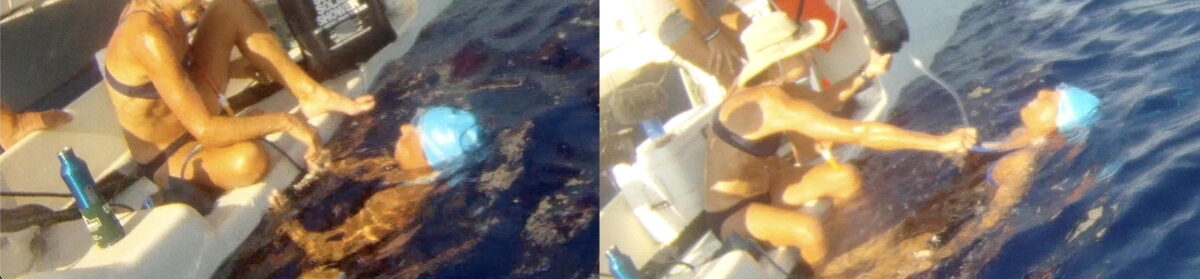
Above: Nyad goes on the record with four of her grandest lies. The truth: Nyad was the seventh woman to swim around Manhattan, completed the Lake Ontario race in four hours and 23 minutes in 64° to 66° water, and never qualified for the Olympic Trials — which is why she didn’t know that the 1968 U.S. women’s Trials didn’t have an electronic scoreboard. And whatever Nyad did in the Florida Straits in 2013, it wasn’t squeaky clean.