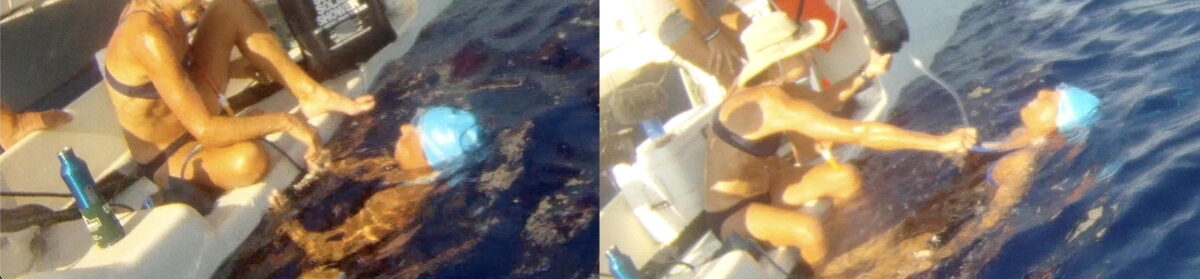
Author/speechwriter/swimmer Rebecca G. Morris — not to be confused with journalist/editor/true crime writer Rebecca T. Morris or artist Rebecca no-middle-initial Morris — wrote a series of quirky features for the New York Sunday News in the 1970s.
For example, she surprised foodie friends with a meal of camping cuisine in “I freeze-dried my dinner party.” In “The Scuba Cops,” she documented a day she spent with the NYPD’s Underwater Recovery Team as they searched for cars, guns, and bodies. And in “The Challengers of the Channel,” Morris chronicled a meeting between Diana Nyad and Gertrude Ederle. (I’ve written previously about Nyad lying to Ederle during that meeting.) The Sunday News published “Challengers” on August 1, 1976, five days before the 50th anniversary of Ederle becoming the first woman to swim the English Channel.


Nyad would leave for England later that August to try to become the first woman to complete a two-way crossing.
She brought a documentary film crew along to record her success. That was the plan, anyway. “You either make it, or you pass out and can’t make it,” Nyad told Ederle. “But you don’t quit!” By the beginning of September, Nyad had quit three times without crossing once.
She never returned to try again. The following summer, Canadian Cindy Nicholas completed the double in 19 hours and 55 minutes, almost two hours faster than the fastest man. Nicholas eventually crossed the Channel 19 times. That included five two-ways, more than anyone in history.
Rebecca Morris and Diana Nyad Meet Again
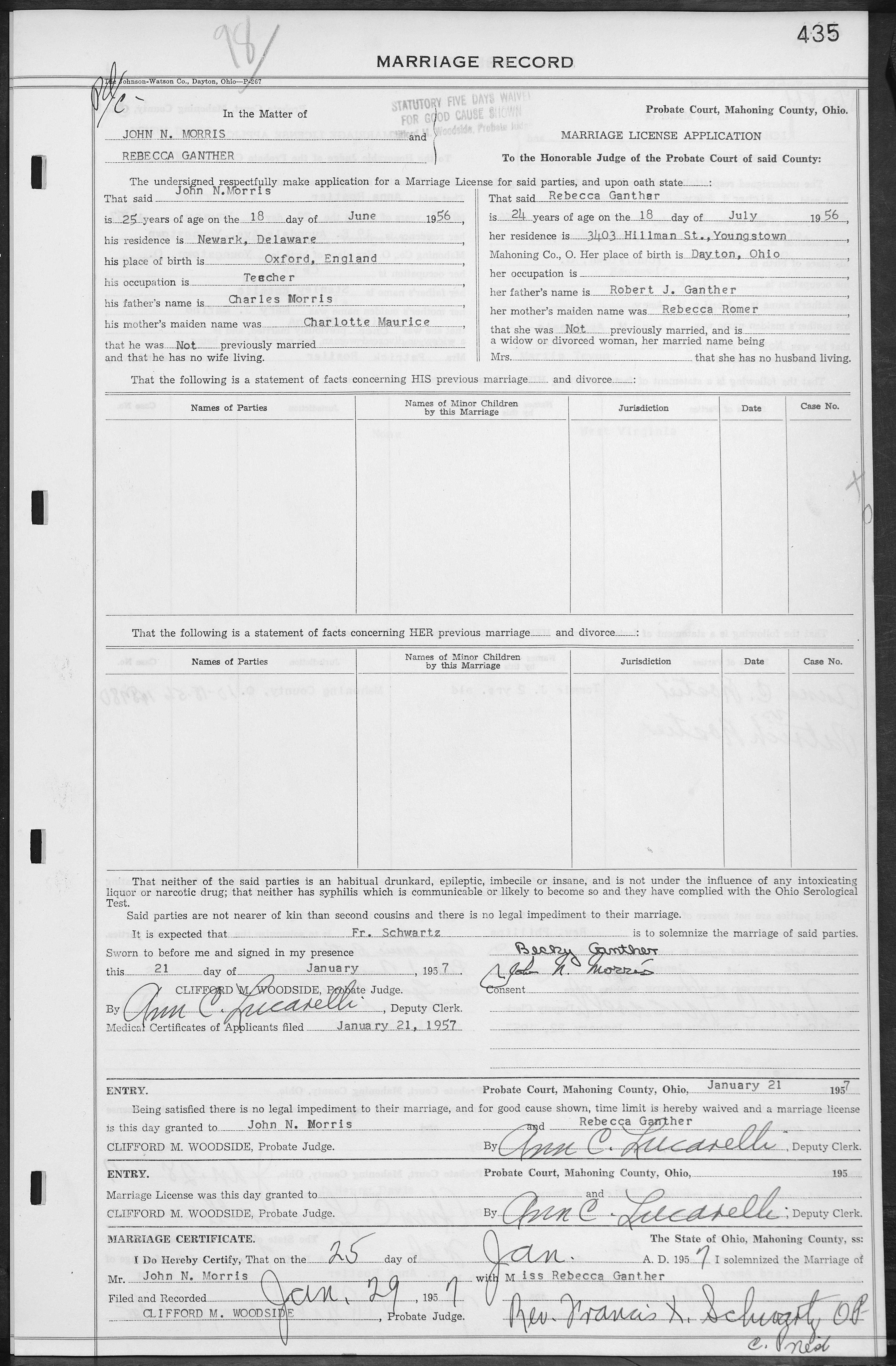
I tried to find Morris, hoping she’d saved her notes from the Nyad-Ederle meeting; maybe some interesting bits hadn’t made it into the article. During the search, I learned that 24-year-old Rebecca “Becky” Gandler married poet John N. Morris in 1957. The marriage lasted less than two years, but the breakup led to what Morris calls her “single score,” her short story “The Good Humor Man.” The New Yorker published it in 1967, and MGM adapted it into the 1972 film “One Is a Lonely Number.”


At least four anthologies include Morris’s story:
- bitches & sad ladies: an anthology of fiction by and about women (1975)
- Solo: Women on Woman Alone (1977)
- American wives: 30 short stories by women (1986)
- Splash! Great Writing About Swimming (1996)
A more accurate subtitle for that last compilation would be Great Writing (And A Diana Nyad Article) About Swimming.
Splash!’s editor — poet and swimmer Laurel Blossom — includes Morris’s “The Good Humor Man” alongside works by better-known authors like Mary Oliver, Calvin Trillin, Stevie Smith, John Updike, and Doris Lessing.
Blossom also includes pieces by swimmers like Australian Olympian and world record holder Dawn Fraser and her countrywoman, the swimming pioneer and world record holder Annette Kellerman.
“I have been asked ten thousand times why I like to swim,” Kellerman writes, “and I have given a different answer every time. You see the water always teaches me a new story.”
Then there’s Diana Nyad, for whom the water’s story never changes: “I look out at the lake,” she writes, “and wonder what it will do to me.” What new and trumpetable torture must she endure this time?
Blossom organizes Splash! alphabetically by author, so Nyad’s contribution, “Mind Over Water,” directly follows “The Good Humor Man.” It’s as if the anthology gods were demanding a comparison. I don’t dare disappoint them.
“Backsides To Heaven”
In Morris’s semi-autobiographical story, a New York City public pool becomes a refuge for a young woman whose husband leaves her and divorces her from across the continent. “All through that hot, slow summer,” the story opens, “I lived alone, on ice-cream sandwiches and gin.”
But as the summer progresses, water and friendship help the narrator begin to heal. In a triumphant moment towards the end of the story, she joins two of the pool’s lifeguards in a dive:
We link upper arms tightly to make a pivot of our shoulders, and at Rocky’s signal, we begin flexing for spring, playing the board. “Now!” We are lifted and thrown upward, tucking into the air. The pool turns upside down, sky spins our knees, the bathhouse revolves. We turn, holding together like monkeys, high above the glazed water. I have a snapshot Mr. Provenzano took of that historic moment. In it, we hang, crouched against the sky, backsides to heaven; one second later we will cut the water together, perfectly straight, to shouts and cheering.
The narrator’s “historic moment” is personal. She has survived a perilous time: “The long summer is over at last,” she concludes. “Summer is over, and I have kept my head.”

“My Emergence Is What It’s All About”
In “Mind Over Water,” Nyad’s head, as usual, is concocting ways to show the horrors of swimming. By conquering the water and the trauma it ostensibly inflicts, she receives the fame and adoration she craves.
For Nyad, historic moments are public moments; without external recognition, her actions have no meaning:
After the pain, the cold, the hours, the distance, after the fatigue and the loneliness, after all this comes my emergence. And my emergence is what it’s all about.
First published in the October 1975 issue of Esquire, “Mind Over Water” is a remarkable artifact, a stone tablet upon which Nyad engraves her desperation. Nine of its 21 paragraphs contain exaggerations and lies. In 11 of the remaining 12, Nyad either brags, describes marathon swimming ordeals, or both.
In the first paragraph alone, Nyad
- lies/brags — “I have been working on swimming since I was ten, four hours a day or more, every day . . . .” (Nyad didn’t begin swimming competitively until she was 12, and she would have gone years before reaching “four hours a day or more.”)
- humblebrags — “. . . skipping the greater part of my social life, not a huge sacrifice, but something.”
- brags again while demonstrating ignorance and arrogance — “I have put more grueling hours into it than someone like [former world No. 1 tennis champion] Jimmy Connors will ever know in a lifetime. . . . There is simply no way he could comprehend the work that goes into marathon swimming.”
- expresses passive-aggression — “I don’t begrudge [Connors] his talent” [as if he hadn’t spent thousands of hours forging his talent into mastery — DS].
Later in “Water,” Nyad lies about forcing five-time world champion Judith de Nijs into retirement. Nyad’s been telling that tale for years, but her “Mind Over Water” version includes a second, newly-fabricated retirement myth: She says that another world champion, Marty Sinn, forced Greta Andersen — International Swimming Hall of Fame Inductee, Olympic gold medalist, and the first person to complete a two-way crossing of a major channel (Catalina, 1958) — to leave the sport.
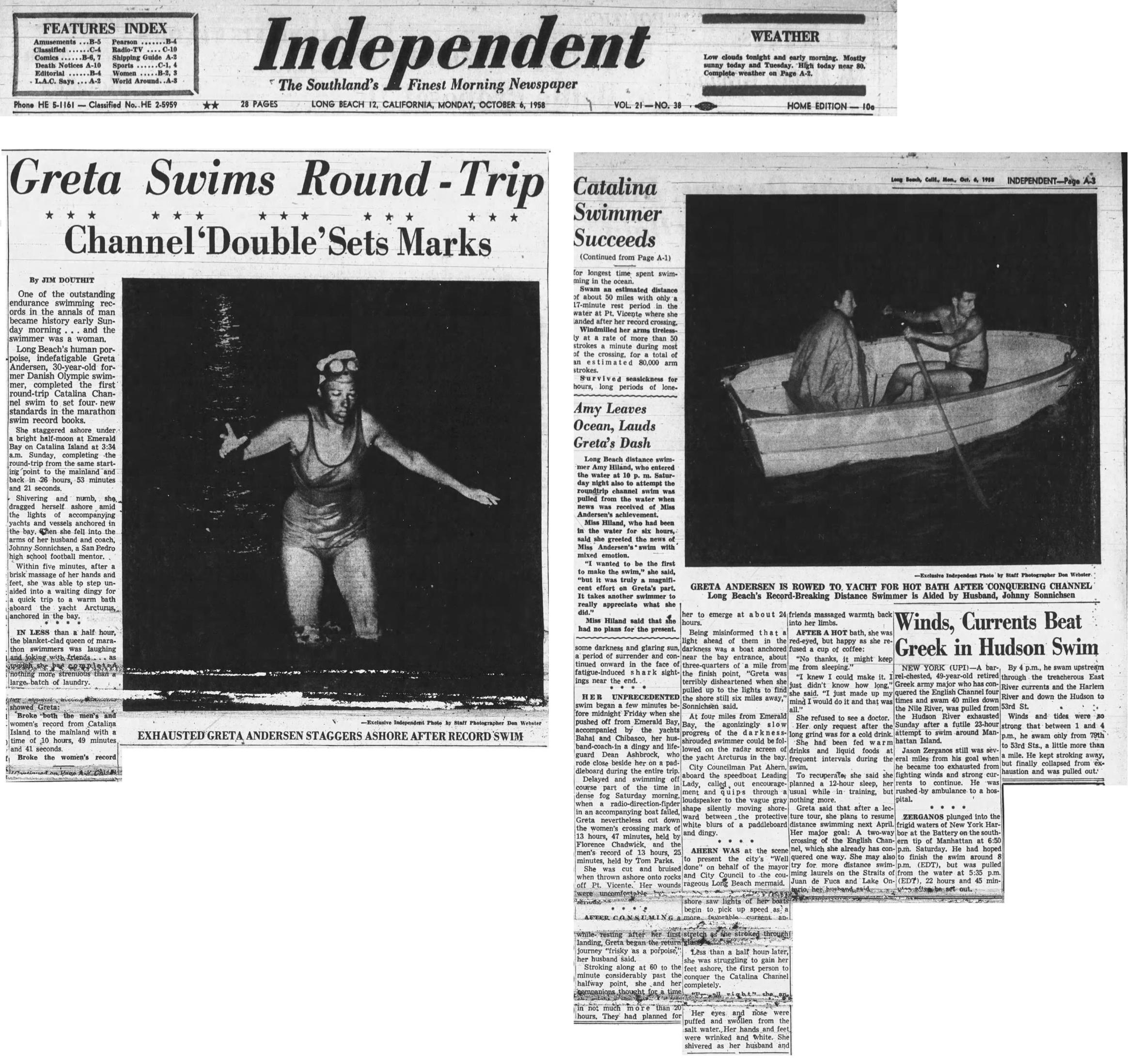
Nyad writes that Andersen
could have gone on forever. But she said that if another woman ever beat her, she’d quit. When Marty Sinn beat her, Andersen kept her word.
None of that is true.
At the 1962 Canadian National Exhibition (CNE), Marty Sinn beat Greta Andersen.* Five days later, Andersen took home $10,000 for placing first overall in a 50-mile race in Lake Michigan. She went on to compete and do solo swims into the early 1970s.

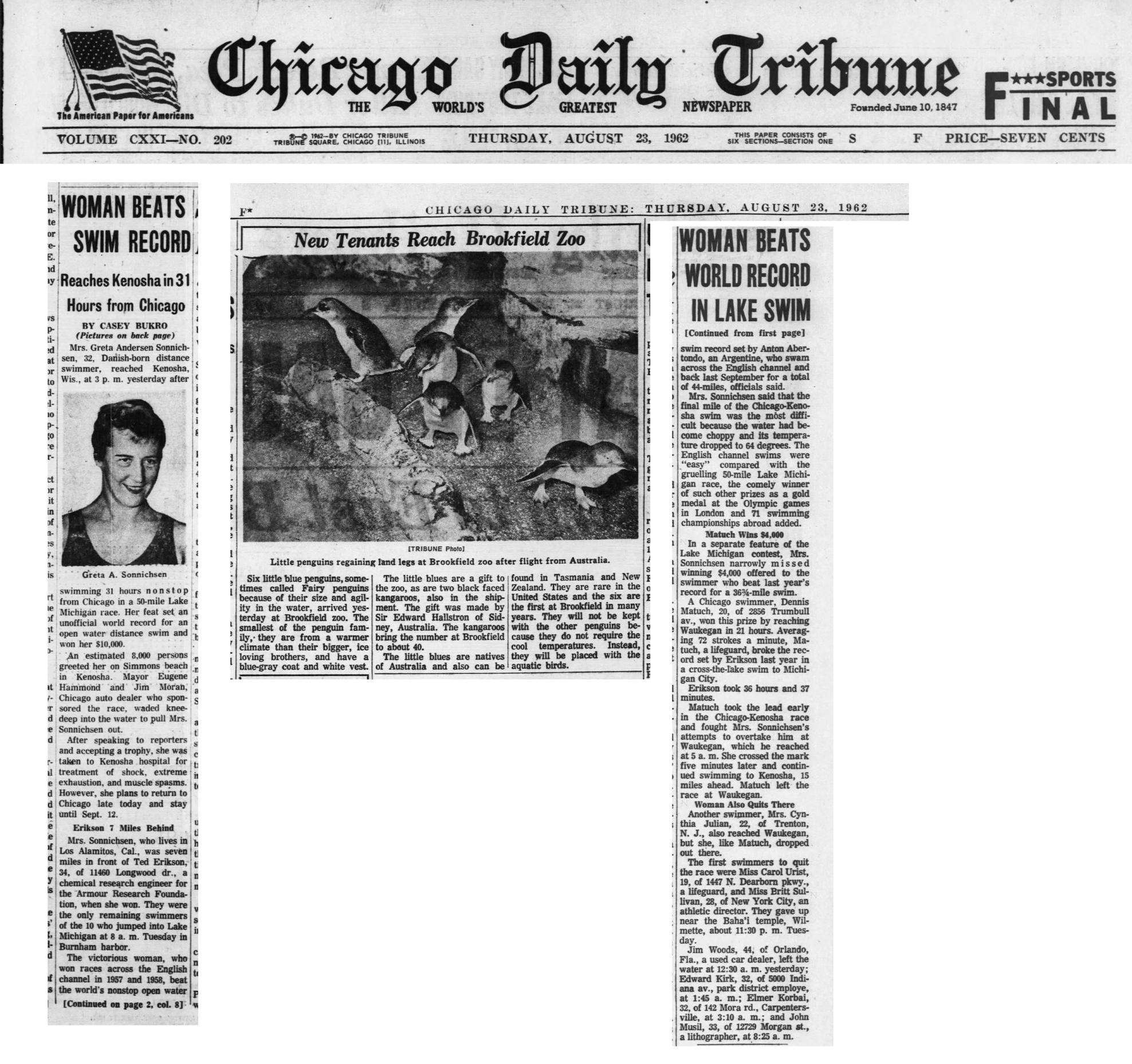
*The 1962 CNE was a 15-mile race in Lake Ontario. Andersen dropped out after 12 miles. I suspect she dropped out on purpose. Andersen likely intended to use the CNE as a warmup for the Lake Michigan race five days later, so she didn’t want to tire herself.
Andersen probably figured she couldn’t outswim Herman “Flying Dutchman” Willemse, the eventual CNE winner, in a 15-miler. So, she could earn at most $4000 ($2500 for second place plus $1500 for being the first woman finisher). And she rightly figured she could outlast everyone at Lake Michigan. The race began in Chicago with ten participants. When Andersen finished in Kenosha 31 hours later, eight had left the water. The only remaining swimmer, Ted Erikson, who had become the first person to cross Lake Michigan a year earlier, was seven miles behind.

Just a Suit, Cap, and Goggles
In the one paragraph remaining, Nyad tells the truth. But don’t get too excited; it’s a truth she later scrapped:
A legal marathon may be undertaken only in a regular racing suit, cap, goggles, and grease.

(For a paragraph-by-paragraph breakdown of “Mind Over Water,” please see this analysis.)

Goodbye Blues
In February 1978, the Daily News published Morris’s “Shaking Off The Blues,” in which she suggests constructive ways to pass long New York winters, like learning to juggle, play the bagpipes, and belly dance. The News included a full-page photo of a belly dancer.
At the time, Citibank’s CEO was looking for a speechwriter. He’d hired a recruitment firm, but they hadn’t sent him anyone he liked. When he saw “Shaking Off The Blues,” he asked the firm, “Why can’t you find me a writer like this?”
After they realized he wasn’t talking about the dancer, the head recruiter called Morris. “My ‘real’ writing life ended there,” she says,
although I grew skilled and more valuable to the world that began to pay my wages. Corporate writing is hard, and I rarely saw the sun. However, I am not on the streets and can pay to print this collection.

Morris tells that story in “How I Became Solvent,” the last chapter of her only book, the self-published anthology How the Camp Fire Girls Won World War II (2017). In chapter one, “You’ve Got To Begin Somewhere,” Morris explains that “the purpose in writing — assembling — this book, read or not, is to earn an LC [Library of Congress] number. I do not want to just disappear.”
Even without the Library of Congress number, she won’t disappear if I have anything to say about it. Any required reading list for Nyad heretics must include “Challengers of the Channel,” with its proof that Nyad shamelessly lied to Ederle, one of the greatest all-around swimmers in history.
Another Nyad-related reason that Rebecca Morris will never disappear: In “The Scuba Cops,” she names the NYPD diver — Benny Manuella — who pulled Nyad out of the East River after her first attempt to circle Manhattan. No other source gives that information.
Unfortunately, Rebecca G. Morris died in 2021. Before I learned that, though, I emailed Rebecca T. Morris, an author with many LC numbers, to thank her for documenting the Ederle-Nyad conversation. She quickly and kindly set me straight.
So, if you know where I can find Rebecca G. Morris’s notes from the summer of 1976, please contact me.

I love “The Good Human Man” and like to read it again each summer as I resume swimming in a public pool in East LA. But each year I forget how I found the story on-line and spend a lot of time, clicking around, stymied by pay walls. This year I found your website and learned all these wonderful details about Rebecca Morris. And, I see where I first encountered the story, in Bitches and Sad Ladies, which sends my mind back to a writing class I was in in 1975. Thank you for this gift.
Erica,
You are so welcome! I can’t tell you how happy I am that the post helped you get back to Morris’s story. Your message made my day.
And thank goodness for public pools. I hope to return to my local one next week.
-Daniel
I was happy to find this piece that celebrated dear Becky. I will always remember her for her funny gifts, her love of literature and all NYC take-out, and her trying to teach my daughters some synchronized swimming moves when she would visit Green River, VT. An unforgettable woman!
Thanks for your delightful message. I’m so glad you found the post. I can’t tell you how happy it makes me to know that there are others out there celebrating Rebecca Morris.