Background
When Equal Visibility Everywhere founder Dr. Lynette Long applied for a Nyad Marker in 2017, she intended it primarily to honor Diana Nyad’s 2013 Cuba-Florida crossing; the first two-thirds of the original marker text addressed the Cuba swim. However, the Florida State Historical Marker Program has a regulation that states
No individual may be mentioned in a marker text until thirty years after the death of said person or thirty years after the significant event with which that person is associated . . .[1]
So, Dr. Long began changing the text to sidestep the 30-year rule. For example, the original text began: “On September 2, 2013, at the age of sixty four, Diana Nyad staggered onto Smathers Beach in Key West, Florida.” The text the Marker Council finally approved in 2018 begins: “As a child growing up in Fort Lauderdale, Diana Nyad was a champion pool swimmer.”
I don’t know the exact text as it currently stands, so I’ll use the 2018 version. That text includes four of Nyad’s accomplishments. According to Dr. Long, all four have been “validated by the State of Florida.”[2]


Analysis
A Champion’s Roots
“As a child growing up in Fort Lauderdale, Diana Nyad was a champion pool swimmer.”
The marker text doesn’t say what it means to be a “champion pool swimmer,” but Diana does:
- In 1971, she told Sports Illustrated that she won six 100-yard backstroke state championships in her last three years of high school. However, the Florida High School Athletic Association has never held more than one championship per year.
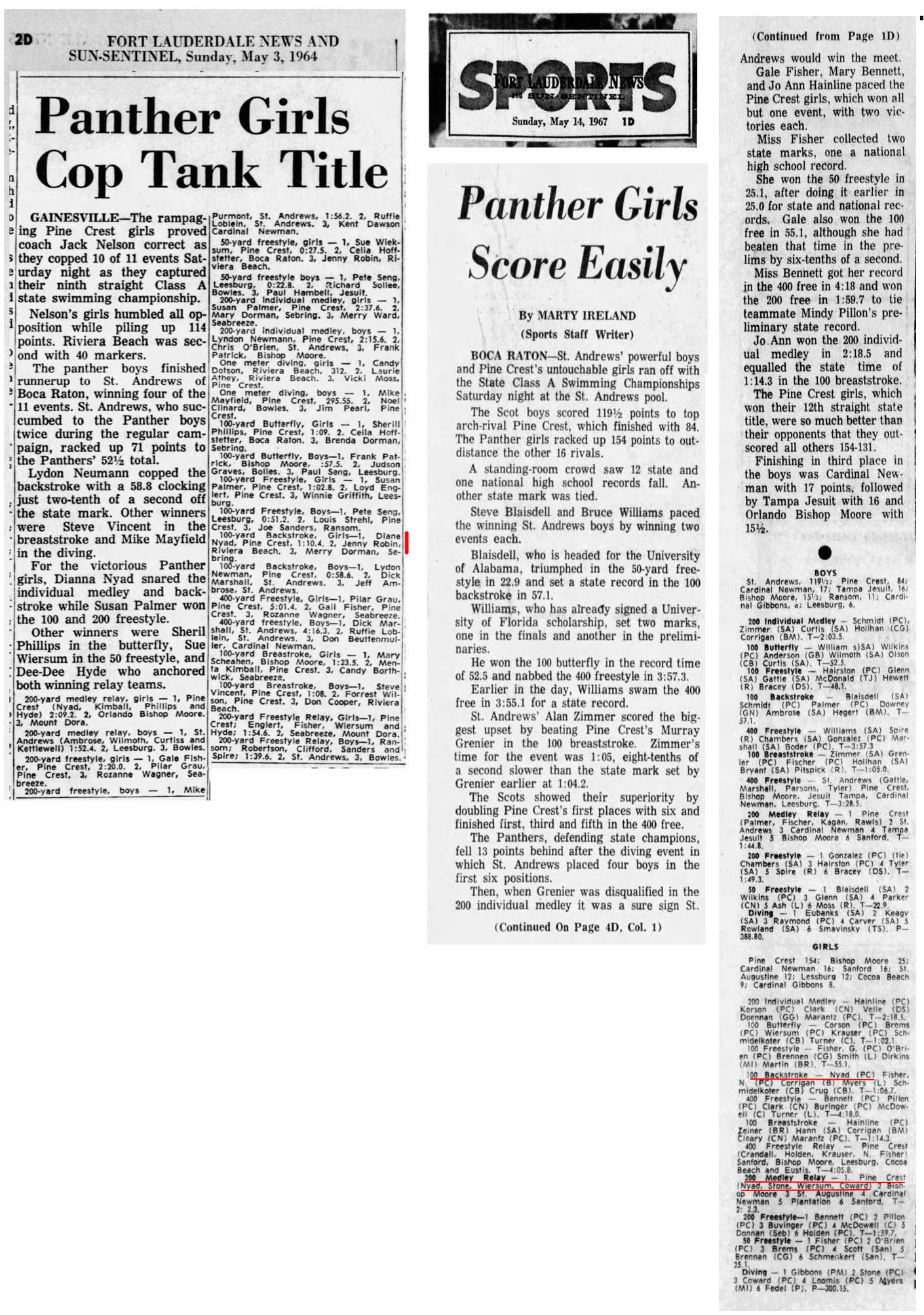
- She said that “by the age of 14,” she had become the best backstroker in the state (archived). In 1964 and 1967, she did win Florida High School Class A titles in the 100-yard backstroke. However, in neither year was she the fastest high school backstroker in Florida.[3]
- She said she was “the Florida State High School 100 and 200 meter Backstroke Champion,” even though U.S. high school competitions don’t include those events.[4]
- She said she won a national championship and set a world record in the 100-meter backstroke. Yet, the closest Nyad came to either was a 19th-place finish at the 1966 AAU Nationals.

“She later trained off of [Las Olas] beach...”
No evidence — no newspaper reports, videos, photos, etc. — substantiates Nyad’s contention that she trained in the ocean off Las Olas beach. Plenty of evidence shows that she didn’t learn about the sport of marathon swimming until at least two years after graduating high school and leaving Florida.
At 18, Nyad entered Atlanta’s Emory University, later moving on to Lake Forest College near Chicago. While she was attending Lake Forest, Buck Dawson, then Executive Director of Fort Lauderdale’s International Swimming Hall of Fame, introduced Nyad to marathon swimming. Nyad told the Fort Lauderdale News that Dawson

came to me in the spring of 1970 [Nyad turned 20 in August 1969] and said, “You’re unhappy with your swimming career because you didn’t make the Olympic team. Why don’t you come up to Ak-o-mac and train?” [Ak-O-Mak is a summer sports camp for girls in Canada. Dawson’s wife Rosemary directed it from 1941–1991.]
A May 1970 letter Dawson sent to swim promoter Joe Grossman confirms the timing:
We are training a marathon swimmer to re-inject some glamour into the races this summer. She is a Greek girl (Greek father, American mother), beautiful, determined. . . . Even though she speaks perfect English, I think we can honestly list her as Greek and play up the glamour in our promotion. [Nyad’s biological father wasn’t Greek, though her stepfather was.]
In neither of her memoirs does Nyad mention practicing in the sea off Fort Lauderdale. However, in her first memoir, Other Shores, she mentions training in Canadian lakes, and in pools in Illinois and Michigan. Nyad occasionally tells other versions of how she discovered marathon swimming, but she’s always 20 or older.
“...and became one of the best ocean swimmers in the world.”
Diana Nyad was never one of the best ocean swimmers in the world. She hasn’t completed any of the world’s major solo ocean swims. She attempted the English Channel — the iconic solo swim — three times and failed each time. Like many “facts” about Diana Nyad, her status as “one of the best in the world” originated with her and her promoters.
Lake Ontario and Manhattan (and Gertrude Ederle)
“At age 24, she was the first person to swim north to south across Lake Ontario. The record swim took 18 hours and 20 minutes.”
The Lake Ontario swim was the first leg of her attempt to complete a two-way crossing. Just after the swim, Nyad told The Globe And Mail that she passed out about two hours into the second leg. Two years later, Nyad lied about that to Gertrude Ederle — Olympic gold medalist, holder of multiple world records, and the first woman to swim the English Channel.

Ederle’s first Channel attempt failed after her trainer, thinking she was in trouble, jumped into the water and grabbed her. In legitimate marathon swims, touching another person means immediate disqualification. The trainer’s “help” ended Ederle’s attempt. Nyad wanted to show how much she had in common with Ederle. To do that, she had to lie:
“I heard what happened to you on your first Channel attempt,” Diana tells Miss Ederle, “Someone touched you and you were disqualified.”
“The same thing happened to me once,” Diana says. “I’d just swum 32 miles across Lake Ontario and I was going for a double crossing and was signaling for my cup. Another swimmer who’d got in the water to pace me thought I was calling for help; she started to grab me. I tried to push her away and they disqualified me. After 20 hours. I’d been swimming 20 hours!” [See page three of “Challengers of the Channel.”]

Diana Nyad saw Ederle’s feat only in terms of herself. “If I get to the Florida coast,” Nyad said in 1978, “that will be one of the most historic moments in sports. I am not going to compare it to Lindbergh, but it is certainly going to be bigger than Gertrude Ederle finishing the English Channel.” Image via Charles Paolino.
“In 1975, 26-year-old Nyad swam around Manhattan Island in 7 hours, 57 minutes, breaking the previous record by over an hour."
In doing so, Nyad became the seventh woman to complete the swim.
In 1981, during her Basic Training For Women book tour, she began saying she was first and trying to erase from history the six pioneering women who preceded her.
Swimming To Jupiter
“In 1979, she swam 102.5 miles from Bimini in the Bahamas to Jupiter, Florida, in just over 27 hours.”
When measured the way most legitimate marathon swims are measured — via the “shortest swimmable path” (archived) — Nyad’s Bahamas-to-Florida swim was a 60-mile, current-aided crossing. The day after the swim, the Associated Press got the distance right:

 The following day, the headline on the front page of the Los Angeles Times read:

Two years later, Nyad began promoting her ostensible 89-mile Bahamas–to–Florida swim as a world record.
That still wasn’t enough, though, so she added 13.5 more miles:

You can hear her make the 102.5-mile claim at the Philadelphia GEOFest. You’ll also find Nyad’s fabrication in the Miami Herald, The Washington Post (archived), The New York Times, The Wall Street Journal, and USA Weekend. And you’ll find it in numerous books, the authors of which must have assumed that someone somewhere at some time validated Nyad’s claim. (See the Woozle Effect.)

Nyad half-heartedly addresses the falsehood in her 2015 memoir, Find a Way. However, she still calls it a record:
The final distance, point to point, 102.5 miles, must be taken with a grain of salt, though, as the direct distance from Bimini straight across to Miami is sixty miles. . . . It’s a fine achievement for me, and my Team. It’s a world distance record. (Find a Way, 2015, p. 91).
“But it was Nyad’s first attempt to become the first person to swim from Cuba to Florida, a 42-hour endeavor in 1978, which secured her place in the International Marathon Swimming Hall of Fame.”
The International Marathon Swimming Hall of Fame (IMSHOF) doesn’t induct athletes for failed crossings, so the organization doesn’t mention Nyad’s 1978 attempt in her biography. Nor does it mention her 2013 attempt. IMSHOF biographies only include verifiable swims.
“She pursued the dream of a Cuba-to-Florida swim for 35 years, attempting the 110-mile swim five times. In 2013, after 52 hours, 54 minutes of continuous swimming, Nyad’s tenacity prevailed. She made history as the first person to swim from Cuba to Florida without a shark cage.”
Nyad can’t prove she swam the entire distance under her own power. And almost as soon as she finished the crossing, she began lying about it. She hasn’t stopped:
The two independent observers (Roger McVeigh and Janet Hinkle) took detailed notes every minute of the crossing.
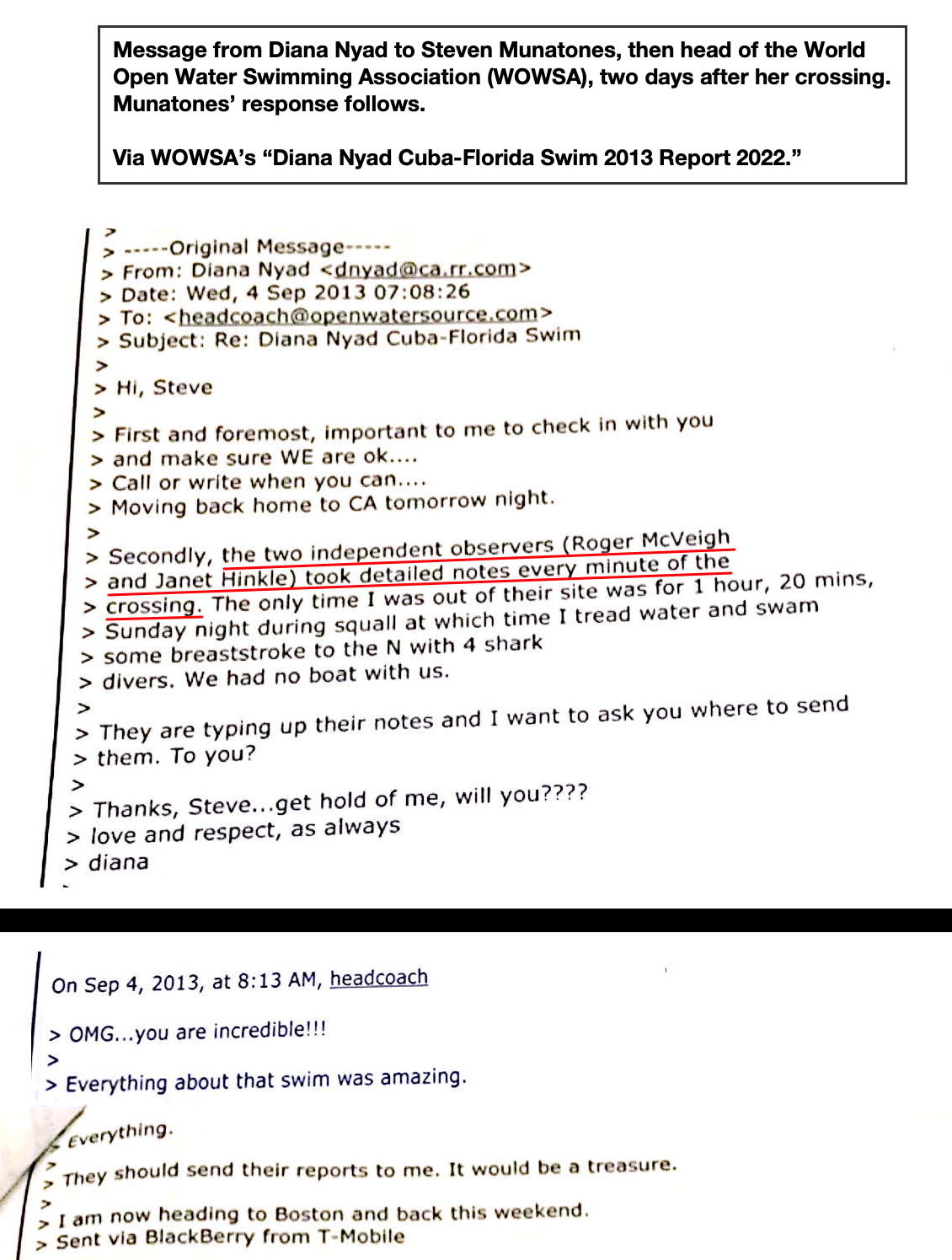
The observer logs contain multiple gaps of up to nine hours.[5]
Every time I stopped for that little sip of fuel for three minutes, get myself together, I’m being dragged due east, and this whole swim is about north, north, north, north, north.
Nyad’s breaks averaged 14 minutes or more. No legitimate swimmer stops that long. Even more puzzling: During those breaks, she didn’t slow down and managed to continue heading north, north, north.
You can never touch the boat or get out on the boat or touch any other person. So you are in the sea on your own.
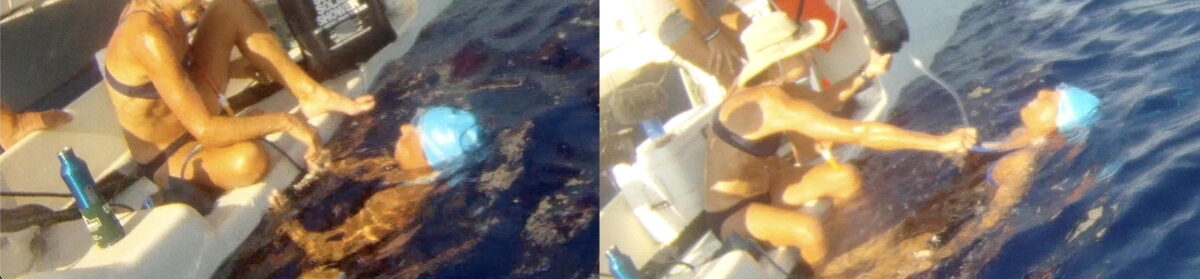
In a legal marathon swim, touching the boat or another person means immediate disqualification. Nyad knows this. So, after the crossing, she said she didn’t touch anyone. She also claimed she got into and out of her jellyfish suit by herself. Images emerged in 2022 showing crew members touching her throughout the crossing and helping her with the suit.

• • •
Despite Nyad’s multiple appeals for official recognition, no legitimate governing organization has ratified or otherwise validated her swim. Most recently, she approached the World Open Water Swimming Association, but its advisory board declined to ratify the crossing.
Since Nyad’s swim remains unverified, any Cuba–Florida crown she claims, including “first crossing without a shark cage,” holds as much water as her 102.5-mile world record, her 37 hours in a 48-degree lake, her five world championships, her sixth-place finish at the Olympic Trials, her claim to be the best marathon swimmer of the 1970s, her 100% box-jellyfish-sting death rate, etc.
A Testament to the Human Spirit
“As she emerged from the sea in Key West, she declared: ‘Never ever give up.’ Nyad’s story serves as inspiration to millions around the world. The Fort Lauderdale native’s achievements are a testament to the power of the human spirit.”
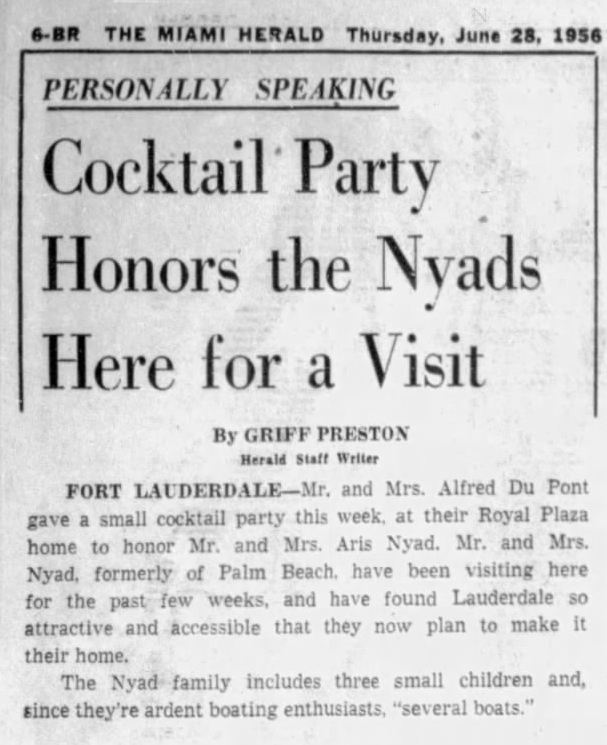
Diana Nyad is not a Fort Lauderdale native. She was born Diana Sneed in New York City in 1949 and moved to Palm Beach around 1953. Her family, which by November of ’53 included Diana’s stepfather, Aristotle Nyad, moved to Fort Lauderdale in 1956. Diana would have been six or seven.


Compare that to what she wrote in her essay, “Remembering 9/11”:
I feel the deep pain of a New Yorker, born there, my first seven years in Manhattan, and later twenty-five more formative years there. It will always be my heart place and now I am not there. I can’t help. I am helpless.
Those are not the words of a Fort Lauderdale native. They are the words of someone using a national tragedy to aggrandize herself, the kind of person New York Times journalist Dan Barry calls a “9/11 narcissist, the hero of [her] own narrative.”
If Diana Nyad’s achievements testify to any sort of “human spirit,” it’s a spirit of egotism and fraud, of repeating falsehoods so often and with such confidence that she deceives almost everyone.[6]

See also:
“Diana Nyad Historical Marker timeline” — from Dr. Long’s first application (May 2017) to the Fort Lauderdale Parks, Recreation, & Beaches Board’s withdrawal of support.
Footnotes
1. A three-member Council oversees Florida’s Historical Marker program. Public Historian Dr. Barbara Mattick was a member of the Council when it first considered Dr. Long’s application for a Nyad Marker. After reading the original text, she was concerned that the Nyad Marker didn’t comply with the rule. In a message to then Marker Program Coordinator Michael Hart, she wrote:
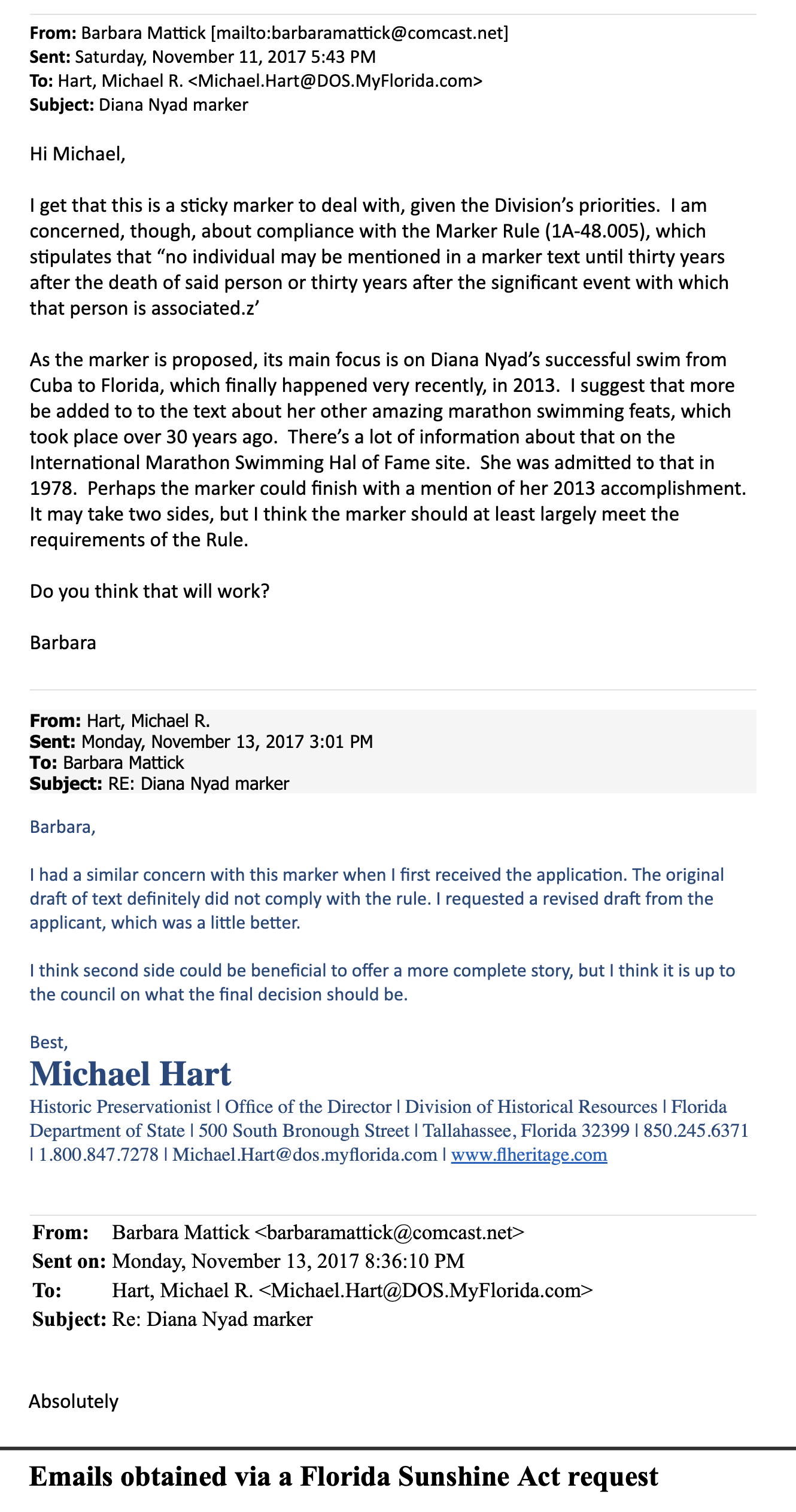
As the marker is proposed, its main focus is on Diana Nyad’s successful swim from Cuba to Florida . . . . I suggest that more be added to the text about her other amazing marathon swimming feats, which took place over 30 years ago.
Dr. Mattick suggested adding a second side to the Marker for Nyad’s earlier feats. No one on the Council seemed to doubt Nyad’s claims about those endeavors.
2. More recently, Alissa Lotane, director of Florida’s Division of Historical Resources, suggested that the approved text may change. “We are looking into the marker,” Lotane said in an email, “and will make a determination on the text before it is fabricated.” That’s a perfect way to put it; any text that makes it onto the Marker will be fabricated in more ways than one.
3. In 1964, Nyad won with a time of 1:10.4. However, Pat Fleming took the 2A division in 1:07.3. In 1967, Nyad won in 1:06.7, but in other races that year, her teammate Nancy Fisher went 1:06.0, and 12-year-old Libby Tullis went 1:05.1. Nyad didn’t qualify for the Nationals in either of those years, so all of the girls and young women who did were faster than Nyad. See results for 1964 and 1967. (I found a few of the competitor’s ages. They ranged from 13 to 18.)


4. Nyad has claimed to be the “100 and 200 meter backstroke champion” many times, including in
-
-
- Her first memoir, Other Shores
- The Miami Herald (page 1, page 2)
- The New York Times
- The New Yorker (archived)
-


However, high schools in the United States conduct their meets in yards, not meters, and don’t include a 200-backstroke.
5. Janet Hinkle and Roger McVeigh had no experience or training as swim observers. By selecting neophyte observers for the most important swim of her life, Nyad guaranteed skepticism would follow.
6. See Tom Stafford’s “How liars create the ‘illusion of truth'” (bbc.com); Brian Resnick’s “Alex Jones and the illusory truth effect, explained” (vox.com); and Evan Osnos’ “Dan Bongino and the Big Business of Returning Trump to Power” (The New Yorker). Osnos cites Texas A&M rhetoric professor Jennifer Mercieca:
Repetition, as every cheerleader and every dictator learns, trains the neural networks to make some thoughts more durable than others. “The more we hear something, the more ‘sticky’ it becomes,” Mercieca said. “If we see something a lot, then it feels true.”
This article presents a critical analysis of Diana Nyad’s swimming claims. It raises serious doubts about the accuracy of her achievements. The implications for the historical marker program are significant.
Thank you, Imran. I couldn’t agree more.