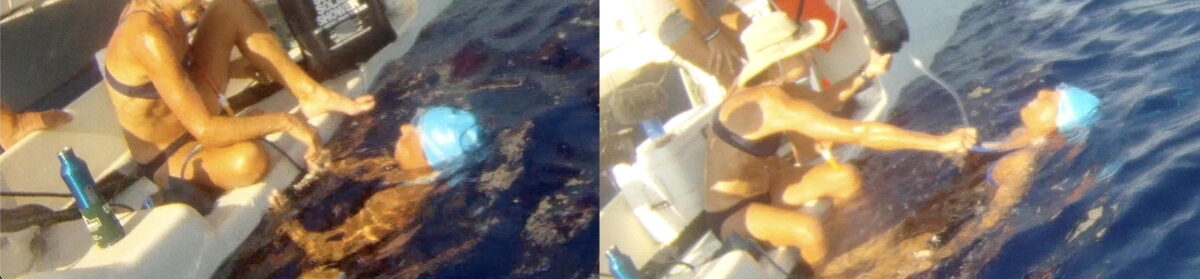
On December 5th, “the most influential and resilient women in entertainment, media and technology gathered to inspire and empower each other” at the TheWrap’s Power Women Summit.
Diana Nyad gave the keynote address. In her first solo presentation since the release of her biopic, she proved again that she is one of the most successful con artists in sports history.
(In a fortuitously apt programming decision, Cassidy Hutchinson, the former White House aide who stood up to another successful but far more dangerous con artist, followed Nyad onto the main stage.)

The Summit took place at the Maybourne Hotel in Beverly Hills, only four miles from my home. I assumed that Nyad would present for at least 45 minutes (as usual) and that, given the $899 ticket price, the organizers would keep her presentation private.
When no one at TheWrap agreed to waive the fee in exchange for a report on Nyad’s lies, I figured that was it — no hope of hearing Nyad’s speech. But within hours of Nyad’s presentation, the entire address appeared online — all 20 minutes of it!
So, here’s a summary of my report: Nyad fabricated every story she told. Taken together, her tales create a set of self-myths. All but one of these myths share a single goal: Retroactively manufacture a destiny.
Whether she does this consciously or not, I don’t know. But it’s an ingenious move: If Nyad’s so-called accomplishments are preordained, how can anyone question them?
Below are the myths Diana Nyad told about herself at the Power Women Summit.
Diana At Five: The Dictionary Story
On her fifth birthday, Diana’s “colorful, histrionic Greek father,” Aristotle Nyad (more on Aris later), opens Webster’s Unabridged Dictionary and, with tears in his eyes and pride in his heart, points to the definition of “naiad.” “‘Girl or woman champion swimmer,’ he reads. “Oh my god, this is your destiny.”
Not a word of that tale is true.
Webster’s published the second edition of its Unabridged Dictionary in 1934. It was still the latest edition 20 years later when Diana turned five. Had Aris opened to “naiad,” he’d have found mythical nymphs, aquatic plants, and fresh-water mussels, nothing more.

No unabridged English language dictionary — and likely no dictionary of any kind — defines “naiad” as a “girl or woman champion swimmer.”
So much for destiny #1.
(In a 2005 version of this story, Diana is “5 or 6,” and Aris doesn’t speak. Instead, he points at the definition and winks at his stepdaughter. “We both understood,” she writes, “this was my destiny.”)


Nyad At Nine: Lucy Plants A Seed
Diana is nine years old and standing on a Fort Lauderdale beach with her mother, Lucy:
I said, “Mom, I know Cuba’s right out here, but I can’t see it. Where is it?”
She said, “Well, it’s just over the horizon. . . . It’s so close, really, that you, you little champion swimmer, you could actually swim there.”
So people say . . . that I chased this dream for 35 years because I tried it first at age 28. Finished it finally at age 64.
But the truth is, it goes all the way back to age nine.
Whenever Nyad says, “The truth is,” she’s about to lie.
She has said at various times that she began swimming at 7, 8, 9, 10, and 11. The truth is Diana started when she was 12. Lucy did not stand on the beach with her 9-year-old daughter, point towards Cuba, and awaken a champion swimmer’s dream. (Also, Lucy would have been pointing toward the Bahamas.)
Diana began swimming competitively in middle school. Her school’s geography teacher, Jack Nelson, also coached swimming. In one of the few stories Nyad tells that remains stable from version to version, Nelson offers anyone in his geography class an A for joining the team.
Nelson began coaching at Pine Crest in the fall of 1961, after Nyad’s twelfth birthday.

Nyad told at least two other How-I-Discovered-Cuba tales before she settled on this one. In one variation, she found the crossing by thumbing through an atlas; in another, she looked at “all the nautical charts of the world.”
She likely told all three stories to conceal the idea’s most probable source: Walter Poenisch. He’d been planning a Cuba-to-Florida swim since at least 1967 and had done his best to publicize it.
So much for destiny #2.

Nyad At 11 & 16: The Return of the Vomiting Valedictorian
At her 6th-grade graduation, Diana saves the day.
Age 11, I was sitting at our little elementary school graduation with my mom . . . and the principal came to me quietly and said Diana, Jimmy (he was the student speaker) . . . is in the bathroom violently vomiting. He is so scared he can’t get off his knees in front of the toilet. Could you say a few words?
Lucy feared her daughter would accept the offer and make a fool of herself. But being the Diana of myth, she wants details. “What were you thinking?” she asks the principal. “Five minutes, seven minutes?” And the rest is oratory history.
Nyad says she doesn’t remember the speech, but her mother did. Funny, though, how her 6th-grade oration replicates a 5th-grade essay she also talks about. (At times, she also places it in grades two and three. Numbers often become unstable around Diana.)
After Nyad saves graduation day, her mother says
Number one, I will never talk you out of public speaking again. Number two, you know your father thinks your destiny is to be a swimmer. I don’t. After today, I think your destiny is to inspire people to reach down to whatever potential they can pursue.
Given the absence of corroboration for this story, Nyad’s history of lying, and the similarity of her speech to an essay to that 5th-grade story, this oration likely never happened.
I’m still looking into it and hope to put destiny #3 to bed soon.
. . .
Diana did give a crucial speech while at Pine Crest, but she never talks about it.
She made the speech in June 1966, when she was 16. Jack Nelson had recently resigned in anger from the Fort Lauderdale Swimming Association (FLSA) over a policy matter.

Nelson quickly changed his mind, but most FLSA board members wanted him gone. So, they met to discuss the issue and vote.
During the meeting, two FLSA swimmers spoke. Adults in the audience laughed and heckled the first, 17-year-old Dick Boling. Nyad spoke next. She commanded the room, silencing the adults who had mocked the previous speaker. “If coach Nelson doesn’t coach,” she said, “we won’t swim.”
Nelson kept his job. Nyad swam for him throughout high school and continued to train with FLSA when she returned home during college breaks. There were other fine coaches she could have trained with in Fort Lauderdale, but she stuck with Nelson.*

turtle

. . .
Nyad stumbled into marathon swimming like most open-water swimmers: By chance. But she wants the media and public to think — and wants herself to believe — that she was always destined for greatness.
So, she fabricates her destiny, backfilling her past with myths.
Speaking of myths, Greek ones in particular, here’s some foreshadowing she didn’t fabricate. When Diana was three, Aris Nyad — elegant, charismatic, broke, and two years from his stint in a Zurich prison — arrived in South Florida. By early October, he’d met the recently divorced Mrs. Lucy Sneed.
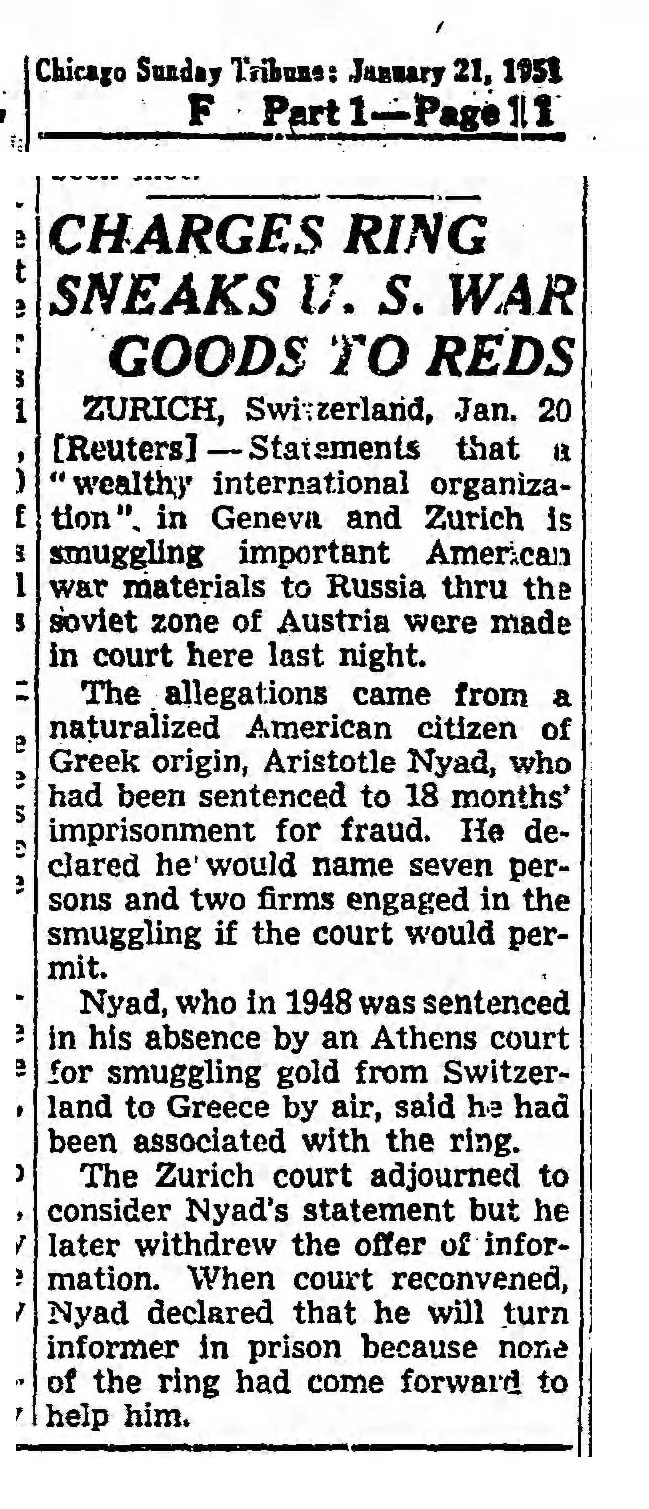

In November 1953, Lucy and Aris eloped to Arizona. A baby girl arrived 7½ months later.
“Aris made his living as a con artist,” wrote Diana in 2005. “He engaged in gambling and scams, and evidently dabbled in a potpourri of illegal activities. . . . [He] was a pathological liar.”
All of that is true about Diana’s stepfather, and it tells us all we need to know about the man who likely determined Diana’s destiny.

. . .
“Can You Believe This Shit?”
No.
I’m in awe of Diana’s ability to convince people to believe her bullshit — for instance, her bullshit-laden memoir; her bullshit-filled movie based on that memoir; and the keynote address she gave at the Power Women Summit, after which the audience heartily applauded her effluent.
Diana Nyad is a compulsive liar. Decades ago, she began establishing a set of myths that proclaimed her fearlessness, determination, mental fortitude, and destiny. To perpetuate these myths, she has to keep lying.
Not to mention the fact that the movie is named after my name. Bonnie and I actually drive to the billboards around town, over and over, and we get out and stand, and we look up and say, “Can you believe this shit? You know, our names and our faces are on giant billboards.”
