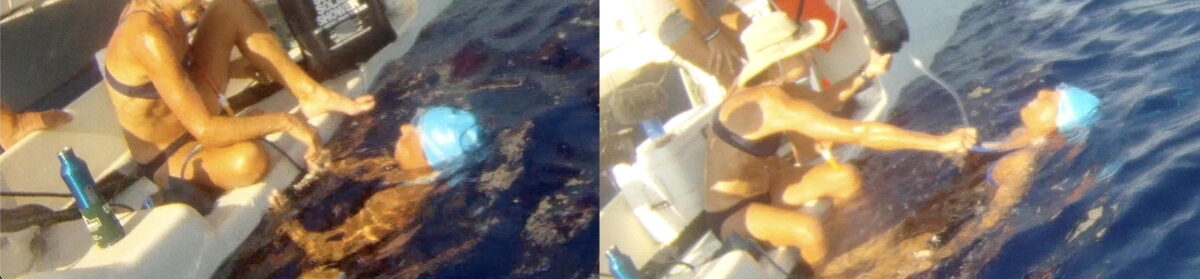

 Skeptics Society founder Michael Shermer reviewed Diana Nyad’s 2015 memoir, Find A Way, for the Wall St. Journal (archived). Plenty of folks had questioned Nyad’s honesty by that time. But Shermer, who makes his living as a skeptic, didn’t betray a drop of doubt. He accepted Find A Way as gospel, going so far as to crown Diana Nyad “the greatest long-distance swimmer in the history of the sport.”¹ (See “Unreliable Natator” for an annotated list of the lies in Find A Way.)
Part of the Skeptic Society’s purpose is to investigate “the paranormal, fringe science, pseudoscience, and extraordinary claims of all kinds” (my italics). So, how could a skeptic’s skeptic miss Nyad’s deception?
For two reasons:
- Shermer left himself open to her con by wanting her story to be true.
- Nyad desperately wanted (and continues to want) Shermer and everyone else to believe. She has peddled the Diana Nyad myth for over half a century, and no one peddles like Diana.

Nyad has spent over 50 years gradually building up the public’s tolerance of her lies while decreasing its ability to question anything she says. If Nyad seduced Shermer, we can’t expect many others to fend off her advances. Nyad has brainwashed her followers into seeing not the real Diana — the selfish one who slanders, lies, and cheats — but the pretend one who is honest, sincere, and humble:
I’m an absolutely aboveboard person who never cheated on anything in my whole life…. I hope they’re not questioning I’m an honest person. (“Celebration Gives Way to Questions”)
The question, though, isn’t: Is Diana honest? The real question is: How can she be so dishonest for so long and keep getting away with it?
I’m going to rely again on author Maria Konnikova. Her book, The Confidence Game: Why We Fall for it…Every Time, describes how con artists con without getting caught (most of the time). Unless otherwise noted, everything that follows comes from The Confidence Game.²
1. Con artists take advantage of our correct belief that most people are honest most of the time. At the same time, they take advantage of our mistaken belief that we’re good at detecting dishonesty.
If we didn’t believe that most people are honest, we’d live in constant fear of being fleeced. As a result, your average less-than-paranoid individual cannot spot a good con artist. After con man Thierry Tilly convinced the family of French aristocrat Christine de Védrines to part with over 6 million dollars, she told The Guardian:
We were simply not armed to deal with someone who lied on such an extraordinary scale.
Few are. “We haven’t really evolved to spot lies,” Konnikova told The Atlantic:
Instead, we like to think that we can tell [when] people are lying because…it makes us feel better, it makes us feel like we are good judges of character, it makes us feel like we know what’s going on. So we often think that we are much better than we are.
How can someone look you right in the eye while telling bald-faced lies? Here’s how:
We expect liars to cue us somehow. We expect them to exhibit at least a hint of shame. But good ones don’t. All the signs we expect — gaze aversion, lack of coherence, nervous tics, facial expressions, frequent pauses, etc. — are absent in a great liar like Diana Nyad.
2. Con Artists Give Us Something to Believe In.
It’s the oldest story ever told. The story of belief — of the basic, irresistible, universal human need to believe in something that gives life meaning, something that reaffirms our views of ourselves, the world, and our place in it. (Konnikova, 4)
Everyone wants to believe in something. Even Michael Shermer — outspoken atheist, questioner of the unquestioned, doubter of the doubtless — wants to believe. Along comes the Church of Diana to fill the void:
As most of the world knows, in 2013 Ms. Nyad finally made it to Florida…. It is the longest unaided open ocean swim in history, and she did it at age 64. “Find a Way,” however, is not just a recounting of that successful crossing. (Shermer)
Konnikova explains:
Give us a compelling story, and we open up. Skepticism gives way to belief. (7)
In her twenties, Nyad attempts a seemingly impossible athletic feat. She fails, then gives up on the dream forever.
But wait! Thirty years later, the dream roars back to life. At sixty, Nyad tries again. Fails again. And again. And again. Finally, at 64, facing the prospect of looking like a quixotic kook, she takes one last shot…and succeeds. What a story!
We believe because we want to, not because anyone made us. And so we offer up whatever they want — money, reputation, trust, fame, legitimacy, support — and we don’t realize what is happening until it is too late…. The well-crafted narrative is [her] absolute forte. (Konnikova, 6)
We want to trust Nyad because she tells us that we, too, can do anything if we put our minds to it and never, ever give up. We want to be told that everything will be more than okay and that we won’t grow old. Or, if we HAVE to grow old, we can, at the very least, rage so hard against the dying of the light that it won’t have the gall to dim.
[A con exploits] our endless taste for an existence that is more extraordinary and somehow more meaningful…. As long as the desire for magic, for a reality that is somehow greater than our everyday existence, remains, the confidence game will thrive. (Konnikova, 8)
3. Con Artists Exploit Our Comfort with the Familiar.
We are more likely to think something is true if it feels familiar. (Konnikova, 163)
Familiarity with — and exposure to — a person makes us more inclined to trust her. Experiments show that we don’t have to remember the exposure. Mere exposure without recall still breeds trust. We’ve been exposed to Nyad, whether we remember it or not, for over 50 years.
One of the first things a con artist does is establish trust — often by being the exact type of person [she] thinks you aspire to be, or at least, want to be associated with. Someone like you. Someone you would like to become. (Konnikova, 154)
4. Con Artists Manipulate Our Emotions to Override Our Reason.
Once the con artist has cased us closely enough to identify what it is we want, feeling, at least in the moment, takes over. . . As in that first rush of romantic infatuation, we abandon our reason to follow our feeling. (Konnikova, 91-2)
Michael Shermer is an ultra-marathon cyclist. The Diana Nyad myth represents an ideal for him. Nyad sweeps Shermer off his feet with her “single-minded intensity and strength of will.” Shermer gushes:
Diana Nyad is a force of personality that anyone who meets her never forgets. This drive and dynamism is well captured in the title of her moving memoir “Find a Way.” She has — and her book shows us how we all can.
When we react emotionally, we think reflexively rather than reflectively, just like a con artist wants us to think. We want to believe that, at 64, we’ll be as vibrant and alive as Diana, able to take on the Florida Straits — or at least have a shred of energy when we crawl out of bed in the morning.
Because our emotional responses trump our rational ones,
most any cries of foul play will fall on deaf ears if you’ve already decided you like the person doing the conning. (Konnikova, 95)
A cancer survivor returns from death’s door and wins the Tour de France a record seven times. A driven and brilliant young woman makes an unprecedented medical discovery that could change healthcare forever. A 64-year-old swimmer, after untold pain and misery, finally conquers a 110-mile swim on her fifth attempt, living out her fairy tale.
When we become swept up in a powerful narrative, our reason often falls by the wayside. (Konnikova, 110)
Above: Once upon a time, Diana Nyad claimed to swim all the way from Cuba to Florida. (Clip from her post-swim press conference.)
• • •
Certain kinds of heightened emotion open one up to being played. Studies show that people who experience anxiety followed by relief from that anxiety become much more open to being conned than those who didn’t experience the anxiety in the first place.
 Hence, the success of the snake oil salesman. Do you have a medical condition of any sort? Clark Stanley’s Snake Oil Liniment will cure it!
Is your baby keeping you up all night? Mrs. Winslow’s Soothing Syrup will knock her out so you can get the sleep you deserve.
Are you an aging baby boomer who doesn’t get enough exercise and worries that climate change will soon destroy all life on Earth? Don’t fret! Diana Nyad, a descendant of Mrs. Winslow herself, will show you how to Find A Way!
5. Con Artists Exploit Predictable Thought Patterns that Can Lead Us to Erroneous Conclusions.
What follows are three flawed ways of thinking that can lead to irrational decisions, thus aiding and abetting the con artist.
Sunk Cost Fallacy
The more one invests in something, be it time, money, or emotion, the harder it is to abandon ship — even if leaving makes a boat-load more sense than staying aboard.
We succumb to this in large and small ways. Let’s say I buy a ticket to a movie but realize thirty minutes in that it stinks. I may feel like I have to stay because I already paid for the ticket. But the money I paid for the ticket is a sunk cost — it’s gone. Better to leave in the middle and do something fun or constructive.
On a larger scale, let’s say you’re building a dam. You’ve spent tens of millions of dollars, but you begin to find evidence that the dam is unsafe. Because you’ve already spent so much, you might be inclined to ignore the evidence and continue building.
The U.S. Bureau of Reclamation did just that with the Teton Dam in Idaho. The dam failed in June of 1976:
The collapse of the dam resulted in the deaths of 11 people and 13,000 cattle. The dam cost about $100 million to build and the federal government paid over $300 million in claims related to its failure. Total damage estimates have ranged up to $2 billion. (Wikipedia)
The failure of Nyad’s edifice of lies would have less dire consequences, but the motivation for continuing to believe in it remains the same. We’ve spent so many years investing emotional capital in the Diana Nyad myth that pulling out now would make us feel like fools.
The sunk-cost effect gives us a continued, strong motivation to believe in something even when the landscape has changed significantly since we first invested ourselves in it. In theory, we should only care about new, incremental costs. What we’ve already put into something shouldn’t matter: it’s lost anyway, whatever “it” happens to be — time, money, energy, whatever else. (267)
Cutting losses would mean admitting a mistake, and the psychological costs of doing that [are] simply too high. (270)
Appeal To The Masses (a.k.a Argumentum ad populum)
Everyone believes it, so it must be true!
[My team and I] had a long, long, long, 13-hour conference call with a bunch of [the doubters] and my navigator went through every quarter mile. At the end of that call, almost everyone on that call wrote me to say ‘Diana Nyad swam fair and square, shore to shore from Cuba to Florida.’ (Time Magazine, 27 Oct 2015)
In other words, they’re not questioning me, so I must be telling the truth. (Little that Nyad says about the call is true. It lasted about 3½ hours, and few doubters, if any, wrote Nyad afterward.)
Here’s an excerpt from an email I received after informing a venue that Nyad lies:
We consulted with a half dozen speaker series who presented Diana in the 2013-2015 time frame. All were very pleased with the outcome of their events and none had concerns about the veracity of her claims. In a quick check this morning, none had any misgivings since that time.
Venues have reputations and ticket sales to protect, so they’d rather let social consensus stand in for truth, and a charlatan’s proximity to respectable people disguise her deceit.

Confirmation Bias/Motivated Reasoning
[C]onfirmation bias [is] our predisposition to take in and sift through evidence selectively, so as to confirm what we’re already expecting to be the case. (238)
Michael Shermer calls confirmation bias “the mother of all biases.” Yet he accepts that Diana Nyad is the greatest, despite no evidence other than her own words.
You don’t have to turn over too many rocks to uncover counter-evidence from experts:
[Diana Nyad is] a very mediocre swimmer with a very good publicist. Most of her swims have been failures. For instance, she has attempted to swim the [English] Channel three times and has never finished. (Doc Counsilman, Sports Illustrated)
‘She has a tremendous reputation for not finishing races,’ complains Tom Hetzel, seven-time conqueror of the English Channel. ‘She has gotten more publicity for doing less than anyone I know.’ (People Magazine)
THERE’S no comparison between her and Sandra Bucha. . . In 1975, when they both swam Lake St. John in Canada, Sandra went the 20 miles in about 8 hours and 15 minutes and Diana was 2½ hours behind. . .
Diana is such a joke to anybody who knows anything about marathons. (John Kinsella, Chicago Tribune)

• • •
The Tilly of the Sea
Trust me, this dream [is] too important to me to have any slight thing outside the fair, just, ethical and agreed-upon rules of our sport. I am an honest, straightforward person. Never been anything but. Every attempt I’ve made has been by the rule books. And now this successful crossing was done in [the] same fashion. (Facebook screenshot)

No honest marathon swimmer would need to say any of that unless she’d given reason for doubt. Diana began providing plenty of that decades ago:
It’s true I used to lie, she says. Only to impress myself. I would tell a cab driver a lie — anybody. I don’t have to do that anymore. (“What Makes Diana Nyad Swim?” Village Voice, 1976)
That’s like a hungry lion saying, “I used to eat meat, but I’ve gone vegan. Now, could you please step a little closer?”
- Yes, Diana swam around Manhattan — but she wasn’t the first.
- Yes, she was a decent high school swimmer — but she wasn’t the best in Florida, nor did she ever qualify for the Olympic Trials.
- Yes, she was the champion of the World Professional Marathon Swimming Circuit — for one season (1974). Other women consistently walloped her that year, but she won the crown on points.
- Yes, she made it across the Florida Straits — but under her own power? Unlikely.
Remember Thierry Tilly, the guy who defrauded the de Védrines family of six million dollars? Diana Nyad is the Tilly of the sea.
The good confidence [woman] has been working [her] way up to this very moment, the moment when ‘Too good to be true’ turns into ‘Actually, this makes perfect sense’…. (Konnikova, 122)
So Diana strokes along unscathed despite decades of telling big lies and small lies and lies that lie everywhere in between. Not a word from presenters who pay Nyad up to $50,000 for an evening of fairy tales. Not a sound from award givers who honor Nyad when they could be honoring the honorable. Not a peep from the media — including the New York Times, which published Nyad’s truth-deprived op-ed.*
Despite her history of deceit, almost everyone but experienced marathon swimmers still believe that Diana Nyad would never tell a lie.
She is very good at what she does.
An expertly planted belief is a nearly impossible thing to shake. (Konnikova, 309)
Update, Jan 1, 2024: The Nyad biopic led several journalists to address Nyad’s deceit. Among them:
- Dave McKenna at Defector — “Diana Nyad’s Swimming Brought Her Glory, Fame, And An Adversary Dedicated To Exposing Her Lies.”
- Josh Rottenberg at the Los Angeles Times — “Netflix has Oscar hopes for its Diana Nyad biopic. But the swimmer’s exaggerations cast a pall.”
- Mary Hannigan at The Irish Times: “Sharks continue to circle veteran athlete Diana Nyad’s ocean-swimming achievements.”
Update, Oct 21, 2026: Fixed links and punctuation.
Notes
- Among all the reviewers of Nyad’s books, I’ve found only two who didn’t fall under Diana’s spell. First, Jennifer Kay, who reviewed Find A Way for the Associated Press. Her final paragraph sums up both Nyad’s book and her career:

In person, Nyad can be abrasive and takes up all the oxygen in the room. Her memoir reads much the same way, as if by being the loudest to proclaim the preciousness of life she can quiet her unresolved demons.
Second, Mary Gordon, in her evisceration of Nyad’s first memoir, Other Shores. “Which is it, then,” writes Gordon of Nyad’s initial Cuba-Florida attempt,
a Greek myth, or a nest egg and Studio 54? Who is responsible for this confused perception? Did the TV cameramen who hung over Nyad’s shark cage make the swim more or less romantic, more or less venal? Do money and publicity, which now accompany almost all athletic achievements in America, make these achievements different in kind from what they have been? Would Pheidippides be less heroic if he had run for a cut of the gate? These should be interesting questions to a feminist athlete; Nyad does not address them. (New York Review of Books)
2. Konnikova consulted with Shermer while writing The Confidence Game. She cites him throughout. Shermer includes an excerpt of The Confidence Game on his website and features the book in his magazine.
Delicious irony? Maybe, but I won’t be able to savor it until I get the bitter taste of all this seawater out of my mouth.
In the meantime, I’ll give Mr. Shermer the last word. This riff on confirmation bias comes from his essay, “Smart People Believe Weird Things”:
Rarely do any of us sit down before a table of facts, weigh them pro and con, and choose the most logical and rational explanation, regardless of what we previously believed. Most of us, most of the time, come to our beliefs for a variety of reasons having little to do with empirical evidence and logical reasoning. Rather, such variables as genetic predisposition, parental predilection, sibling influence, peer pressure, educational experience and life impressions all shape the personality preferences that, in conjunction with numerous social and cultural influences, lead us to our beliefs. We then sort through the body of data and select those that most confirm what we already believe, and ignore or rationalize away those that do not.