 The English Channel is the closest thing we have to a Mt. Everest of marathon swims, no matter what Diana Nyad says. I recently finished The Great Swim, a book about the summer of 1926, when four American women went to Europe, all wanting to become the first female to conquer their Everest. It’s a fascinating story well-told. The author, Gavin Mortimer, also writes of the aftermath — how being first nearly destroyed the life of the young and unworldly Gertrude Ederle.

I first picked up The Great Swim because a good chunk of it is about Mille Gade (full name Amelia Gade Corson), the woman who beat Diana Nyad around Manhattan Island by 54 years. Gade makes her best-known swim in that summer of ’26 when she crosses the Channel three weeks after Ederle. Mortimer details how Gade, despite receiving far less recognition than Ederle, fared much better after her crossing, both personally and financially.
The Great Swim, though, is about more than swimming. In particular, Mortimer clearly shows the forces lined up against women who challenged societal norms, like wanting to swim without socks or wanting to challenge the supposed aquatic supremacy of men. Mortimer keeps it suspenseful throughout, even though Ederle makes her historic swim about halfway into the book.
Three Touching Parts of The Great Swim
Before I get to Gade, I want to touch on an aspect of The Great Swim that really grabbed me.

If there is a single article of faith that marathon swimmers agree on (or at least could agree on until recently), it is this: A swimmer cannot touch a boat or another person. Doing so ends a swim—case closed, curtain down, that’s all she wrote. Gavin Mortimer himself may not have swum marathons, but his writing shows that he gets the gospel of thou shalt not touch.
For instance, Mortimer describes how, during feedings on Ederle’s crossing, she is constantly aware of the no-touch covenant. At one point, Ederle’s support boat, the Alsace, moves in close. Bill Burgess, her trainer, dangles in front of the swimmer a small net. It holds a baby bottle filled with chicken broth. Ederle drinks the broth,
all the time making sure she didn’t come into contact with either Burgess’s hand or the hull of the Alsace. To touch either would mean disqualification. (p. 143)
Later, La Morinie, a boat carrying rival journalists — the Daily News sponsored Ederle — motors in close to Ederle mid-swim:
The journalists on board La Morinie were trying to disqualify Ederle. They wanted her to reach out a defensive hand and fend off the tug. No triumph for Ederle or for the Daily News. (p. 146)

Again, Ederle and Mortimer assume that a single touch, even an accidental one, ends the swim.
Later, the heroic Clarabelle Barrett, on her second attempt that summer, taps out by touching the boat.
With a pitiful moan, she reached out and touched the side of the motorboat. She was lifted on board, and for several minutes all Barrett could do was vomit over the side of the boat. Then she slid disconsolately to the deck, mumbling, “I give her [Ederle] credit for swimming across…I will leave all the joys of Channel swimming to Miss Cannon and Mrs. Corson for this year. I’ve had enough. (p. 216)
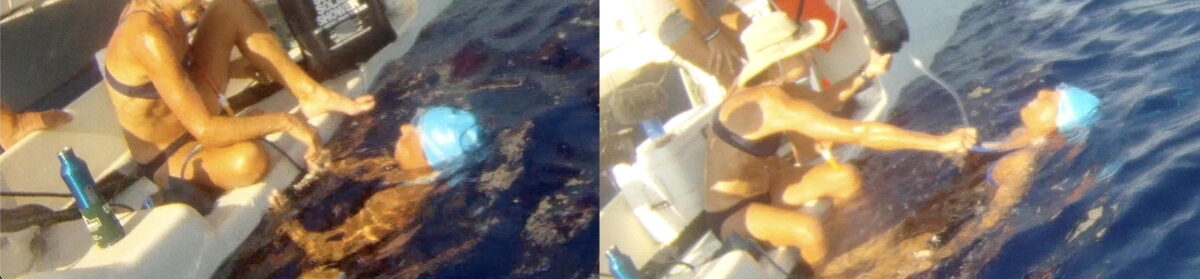
I wonder what Barrett and Ederle, et al. would have thought of Diana’s directional streamer and her overall flexibility with marathon swimming conventions. Nyad knows the touching rule. Hence her denial after skeptics accused her of being touched during her Cuba-Florida extravaganza — “I never, of course, touched a boat or another person” — and her awkward admission later on — “I was on my own steam entirely but I was touched. I agree with it.”

She Can’t Touch Mille
Nyad attempted the English Channel three times in 1978 but never got across. Mille Gade made two attempts in 1926, completing it on number two. Five years earlier, she swam around Manhattan, making her the second woman to do so.
Diana Nyad has said for at least ten years that she was the first woman to circle Manhattan Island. That makes Gade one of the six pioneering swimmers whom Nyad has attempted to erase from swimming history. Mille Gade deserves better.
