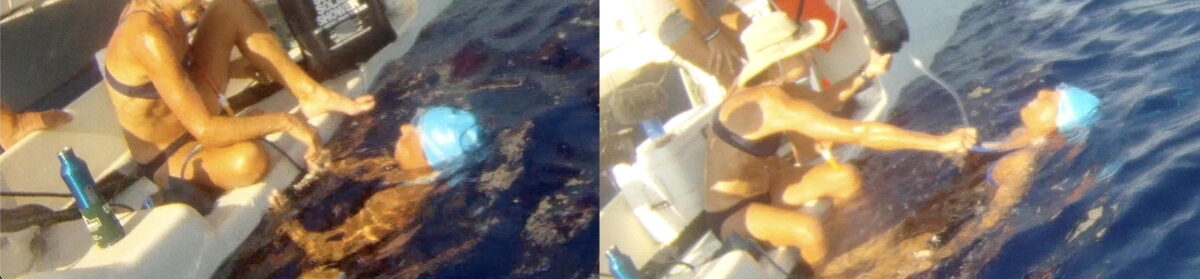

The sun rises and sets, the tides ebb and flow, Diana Nyad lies and lies. Nothing surprising about any of those things. But when a BBC producer lied to me about fact-checking Diana Nyad:
All records and data cited within the Diana Nyad edition have been independently verified by the appropriate sporting bodies.
No sporting body would have verified
In a follow-up message, she said
We’ve looked into your other comments and can find no evidence to warrant further changes to the programme other than the factual errors as detailed above.
They either didn’t look very hard, or they didn’t look at all.
The September 1 episode of the BBC World Service podcast Lives Less Ordinary, “Never ever give up: how Diana Nyad swam from Cuba to Florida,”
Below, I’ve listed some of the original episode’s misinformation and lies. They have since made three corrections, and the episode’s web page state that “This programme has been re-edited and corrected since first published.”
I’m grateful they did this. However, “corrected” suggests that
They changed the following
- [She swam] across Lake Michigan.
- Ms. Nyad was the Women’s World Marathon swimming champion from 1970 to 1975.
- English Channel: In the September 6 episode, Outlook — Lives Less Ordinary’s sister podcast — host India Rakusen says Nyad “crossed the English Channel.” True — as long as Ms. Rakusen refers to doing it by some means other than swimming.
They left everything else. Here are ___ completely fictional stories Diana Nyad the BBC or the BBC repeated (with thanks to CNN’s “Fact check: 12 completely fictional stories Trump has told in the last month.” for inspiration and a template.)
Nyad’s World Record
[She] set a world record for distance swimming for both men and women, when she completed 102 miles, or 164 kilometers, from the Bahamas to Florida.
Like many of her “records,” this one is entirely self-declared and imaginary. Her Bahamas-to-Florida swim was a 60-mile endeavor. For details, see the “Swimming to Jupiter” section of “Diana Nyad’s Magic Marker.”
Internal clock
Nyad says that she can “count time out there like an atomic clock.” If so, it’s an atomic clock that’s about to explode. She gives no examples here for good reason. Whenever she does, she proves she’s lying. For instance, she said in a speech that singing “Me and Bobby McGee” 1000 times takes her “to the second, 9 hours and 45 minutes.” However if she sang it the way she says she did, it would take her 75 hours. She said in another speech that 2000 times through the same song takes her 8 hours and 45 minutes.
For details, see the “Math Problems” section of “Unreliable Natator.”
Marathon swimming origin story
Diana only happened to discover [marathon swimming] while at University. A fellow student saw her doing laps in the pool and said, “Do you know there’s a sport called marathon swimming.”
Buck Dawson, founding director of Fort Lauderdale’s International Swimming Hall of Fame, introduced Nyad to marathon swimming in 1970. or ’71. A fellow student had nothing to do with it. See her first memoir, Other Shores:
Buck Dawson, an old friend, called with a tempting prospect of trying the marathon swimming circuit. . . . He and his wife run a competitive swimming camp for girls in the north woods of Ontario, about four
hours up from Toronto. (p. 20)
See also this May 1970 letter that Dawson wrote to promoter Joe Grossman. Top it off with this summary of Nyad’s marathon swimming origin stories.
On The Manhattan Swim
“Many people to this day come up to me and say, ‘I was there that day.'”
She’s confusing that with her Cuba-Florida crossing. Beginning of swim (according to NYT): “Little knot of bystanders.” “100 newsmen and well-wishers” at end.
The Mount Everest of swims
For me and for lots of other people, Cuba was the one. Cuba was considered the Mount Everest of all the swims on Earth.
Few people have wanted to swim from Cuba to Florida. However, Nyad often says otherwise: “All the great swimmers of the ocean have tried it,” she told an interviewer in 2017, “male, female, young, strong, fast” (Brink of Midnight podcast). Five people have attempted the crossing; three have succeeded. For details, see my post, “Everybody’s Doin’ It.”

No one besides Nyad considers the Florida Straits the Mount Everest of marathon swimming. Again, she wants us to think otherwise:
Now another elite Australian swimmer named Chloë McCardel has her sights on being the first to cross without aid. . . . She is issuing statements about the Cuba Swim being the Mount Everest of ultradistance swimming. (Find a Way, p. 244)
McCardel said that swimming the English Channel is like climbing Mt. Everest, a more accurate analogy. She never called the Cuba crossing “the Mount Everest of ultradistance swimming.” (On October 13, 2021, McCardel completed her 44th English Channel crossing, one more than Britain’s Allison Streeter, the previous record holder for most crossings in history.)
Diana Discovers Cuba
I started that little tickle in the back of the imagination that my mom had planted about “Cuba’s right over there. As a matter of fact, it’s so close you, you little champion swimmer there, you could actually swim there.”
She began workshopping that myth around 2014. It contradicts all the versions she told earlier, when she was more honest about her motivation: “If I make it,” she told a New Jersey newspaper, “I’ll be rich and famous — mostly rich.” See the “Discovering Cuba” summary for more versions of her story.

Bragging rites
“I was in the best physical shape of anybody on the face of the earth for that day, the best prepared for my task.”
[1978 — who else was swimming? But Nyad wasn’t paying any attention to them. To Nyad, there’s only one person marathon swimmer worth talking about.
there’s no way to tell. You can’t compare marathon swims. but let’s look at what some others did in 1978.
- John York completed a double-crossing of the Catalina Channel in. He described his training regimen in a 1979 article…
- Penny Dean (July 29) — first EC under 8:00. A week (?) later, she placed second at the World Championships.
- Cindy Nicholas — single EC, had done a double in 1977, would double again in 1979.
- Des Renford — swam the English Channel twice (at age 50). He’d swim it three times in 1979 and three more in 1980.
- Cindy Cleveland — Anacapa two-way (first single & first double). In 1979, she would become the first person to swim around Catalina.
- Loreen Passfield swaswam the English Channel in 9:02 on August 28, won the world championship crown in 1978 and
“I do believe I have spent more training hours than any other swimmer in history.”
She can’t know that, particularly because she’s never had much interest in other swimmers beyond convincing the press and public that she’s better than they are.
Superhuman resilience
That superhuman resilience, that obstinate refusal to give up. She’s cultivated and nurtured that quality over a lifetime.
“It’s almost like I took a steel helmet of conviction, and I put it on, and I said, ‘There is nothing that would be a surprise to me that will keep me from taking the next stroke and the next stroke.'”
“It doesn’t matter how bad it gets once I put on that imaginary steel helmet; there’s nothing that’s going to keep me from going except Mother Nature.”
No — sometimes she just quits. She makes excuses for her failures on the spot or later.
‘She has a tremendous reputation for not finishing races,’ complains Tom Hetzel, seven-time conqueror of the English Channel. ‘She has gotten more publicity for doing less than anyone I know.’ (People Magazine, 1976)
From Doc Counsilman:
By taking on the Channel, Counsilman also hoped to help plot a truer course for a sport that he feels is being exploited by “phony-baloney promoters.” He cites the example of Diana Nyad, “a very mediocre swimmer with a very good publicist. Most of her swims have been failures. (Sports Illustrated, 24 Sep 1979)
John Kinsella, Olympic medalist, world record holder, and 5-time World Professional Marathon Swimming champion:
Diana is such a joke to anybody who knows anything about marathons. (Chicago Tribune, 27 Aug 1978)

Nyad’s greatest strength isn’t resilience but PR, getting the public and the media to believe her and even lie for her.
Broadcasting career
“Over the following three decades, Diana forged a successful broadcasting career.”
She started with ABC in 1980. By 1987 — after she had “worked out a free-lance arrangement with ABC,” presumably Nyad-speak for “they let me go” or “my assignments dried up to almost nothing” — she’d begun plying her trade elsewhere. Some examples:




Nyad was mostly doing radio by the 2000s. In her 2015 memoir, Find a Way, she says that The Score, her sports commentary spot that debuted on NPR affiliate KCRW in 2004, was her most fulfilling broadcast job.
She also says it lasted 22 years (Find A Way, p. 100).
If that were true, she’d finish in 2026. Meanwhile, KCRW aired The Score’s final episode in 2011.
Sensory deprivation
You’re in this state of extreme sensory deprivation.
Nyad confuses sensory deprivation with boredom. She told the New York Times that marathon swimming “is the most boring sport in the world.” However, she needs to portray her endeavors as one torment after another, and boredom doesn’t sound as agonizing as sensory deprivation.


Swimming is closer to sensory overload than sensory deprivation. From the moment an athlete enters the water, swimming engages all five senses. Here’s Nyad talking about her 2013 crossing:
- “The waves are slapping all night long.” (Find a Way, p. 258)
- “The sun is hot and life-affirming.” (259)
- “Salt water washing over those cuts now causes a constant, throbbing torment.” (259)
- “And I see Bartlett’s head peering out his window, right above the handler’s station. He gives me a big thumbs-up, that grin still beaming ear to ear. (261)
“You’re turning your head. For me, it’s 53 times a minute, like clockwork.”
- Jack Nelson sexually abused her from the age of 14.
Box jellyfish
- “The doctors on board will tell you that they think I lived on will. I should not have survived those things. Many people who were touched by the box die instantaneously. Within a minute or two.”
- “If you’re not going north, you’re going to be dragging east and off course by the Gulf Stream.”
- Diana had done it. Thirty-five years after her first attempt, over 50 years since she first saw that mysterious island in the distance, she’d swum from Cuba to Florida.
One True Thing: Aristotle Z. Nyad
Diana told the truth about her step-father, Aristotle Z. Nyad: He was a thief (in the late 1940s, he was at the center of the largest smuggling operation in Greek history), a con artist (see, for example, his 1943 arrest in Beverly Hills for impersonating an officer), and a serial liar.
Diana’s ability to deceive the public and the media, including the BBC, demonstrates how well she absorbed her step-father’s lessons.

. . .
For the explanations on this page, I’ve borrowed from the following pages and posts:
“The Nyad Apologists Who Say She Hasn’t Lied For Years Need To Explain What Happened Last Month”